


Quality stocks across Europe have lagged as money has chased AI and US growth. However, Fund Manager Nick Davis argues this is not a reflection of weaker European businesses. Instead he argues it is an overdone factor unwind that allows him to take advantage of the resulting disconnect between share prices and fundamentals. He explains why he has been buying steadily through the derating, what could trigger a rerate and why he is not waiting around for one.
Q: Is the investment case for Europe simply that global equity investors are too crowded in AI and US equities?
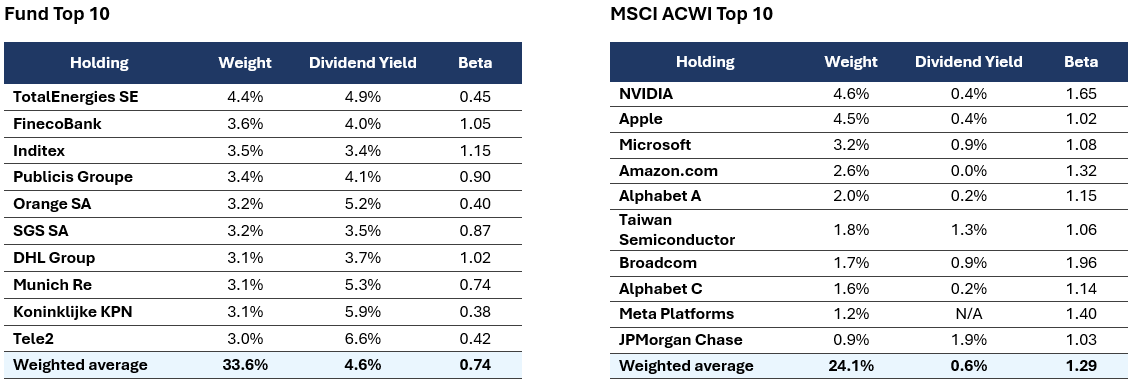
A: Our argument is that Europe’s ‘old economy quality’ stocks are hugely out of favour despite strong fundamentals and are likely a good place to be when the exuberance in markets ends. In our view, global equity indices are too concentrated in technology and US shares – the top 10 stocks in the MSCI All World Index are 9 tech stocks and a US bank.
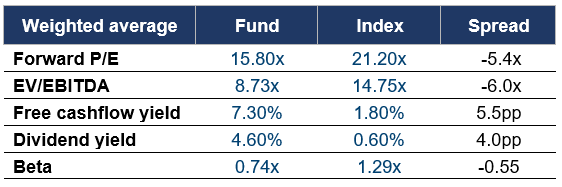
The table below shows why we think our holdings are so compelling. We think the attractions of dividends as a diversifier are evidenced by our Fund’s performance in 2022 and by the general success of dividend strategies in the aftermath of the TMT bubble ending in 2000.
| Polar Capital European ex-UK Income Fund’s largest holdings vs the MSCI All Country World Index |
 |
| Source: Polar Capital and Bloomberg, 31 July 2026. |
The opportunity in European quality stocks today has been created by what we see as their excessive overvaluation, that peaked in 2021, and subsequent valuation unwind. We saw roughly the first two years of their underperformance as fully justified by the derating required to correct previous excesses. We would argue that at some point after that, their underperformance became much more about flows in markets than a repricing of broken business models. Many of the funds that had built successful track records based on the previous decade’s rerating went into brutal outflows. Those outflows went to global funds, index funds and value funds. There are very few investors left willing to catch falling knives despite many of these stocks clearly reaching GARP territory.
Part of the ‘old economy quality’ underperformance has also been caused by the narrowness of stock markets chasing new economy AI plays. Roughly 20% of the European index, largely AI and energy stocks, accounted for nearly all the market's gains in the first half of 2026. The remainder is broadly flat and a large number of very good businesses sit in it.
The other characteristic of markets has been very strong momentum performance, with perceived winners continuing to win and perceived losers losing further ground. Data from Bank of America shows European high momentum stocks outperformed low momentum stocks by 125% between early 2023 and the middle of June 2026. For contrarian investors looking to buy good companies when they are out of favour, that is about as hostile a backdrop as we have worked in. The discomfort of buying low momentum quality is a clear sign to us that this group of stocks is at the wrong price.
The most useful evidence that this is a factor story is the very heterogenous nature of companies in the quality underperformers basket. These businesses share almost no operational similarities. They have different end markets, different competitive dynamics and different sensitivities to interest rates, input costs and consumer confidence. When companies with that little in common all derate together, the only thing joining them is the factor itself. We see this as a factor unwind overshoot rather than a fundamental problem with each individual business. This also makes it an opportunity that can be exploited in a relatively diversified way that does not rely on a particular industry or macro variable working out in a particular way.
At the 2021 peak, these stocks were discounting long-duration cashflow growth that almost no group of companies could have delivered. Many of these stocks now trade on mid-single-digit free cashflow yields (our preferred valuation metric) with long-term track records of at least mid-single-digit growth of those cashflows. Clearly positive real free cashflow yields with clearly positive real growth are highly likely to deliver strong savings outcomes in our view.
Q: Have you increased your exposure to European quality stocks following the recent derating? If so, which sectors or stocks stand out and what makes them attractive?
A: In 2021, the debate was how high a P/E you could justify paying for a quality company. Today the debate is whether these companies are still quality at all. We see this as a much healthier question to be asking and one that our investment process is much better set up to address.
We have been buying steadily out-of-favour quality companies since the start of 2025: 12 new ideas last year and eight more in the first half of this year. To give an idea of the expansion of the opportunity set, we found just three new ideas in the whole of 2021 when so many companies were simply too expensive for us. We have bought more slowly than we would have historically, waiting for proof points that these businesses really are still quality, and trying to balance a compelling entry point against excessive exposure to negative momentum.
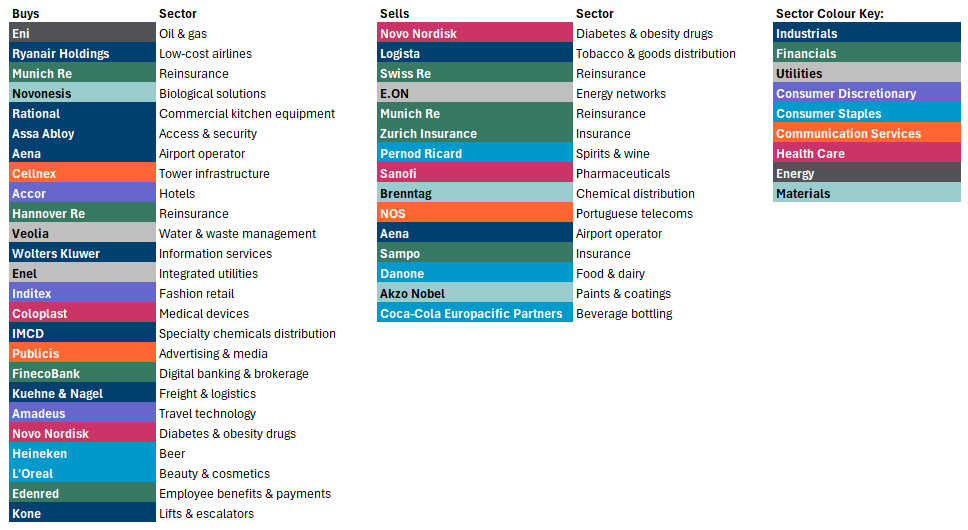
We have been finding new ideas across a variety of industries (see the chart below). We have been adding to digital and mobile infrastructure, telecoms, reinsurance, professional information and business services companies, high-return industrials, travel infrastructure and specialty ingredients. Broadly, these are physical-asset businesses with low obsolescence risk and AI adopters rather than AI picks and shovels.
Where we have been adding and moving away from over the past 24 months |
 |
Source: Polar Capital, 24 August 2026 |
This is not an argument for buying anything that has fallen. We have exited holdings that were clearly failing the ‘still quality’ test, including Brenntag, Pernod Ricard and Novo Nordisk. We are wary of quality companies carrying material China risk, whether that is a weaker domestic market for their goods or increased Chinese export competition elsewhere. We have no exposure to luxury goods, where we think the market is correctly reassessing whether the previous quality characteristics still hold. We have changed our holdings in reinsurance to higher-quality names and reduced the number of holdings in that sector given the cycle is weakening. A cheap multiple does not help if the competitive position is genuinely eroding.
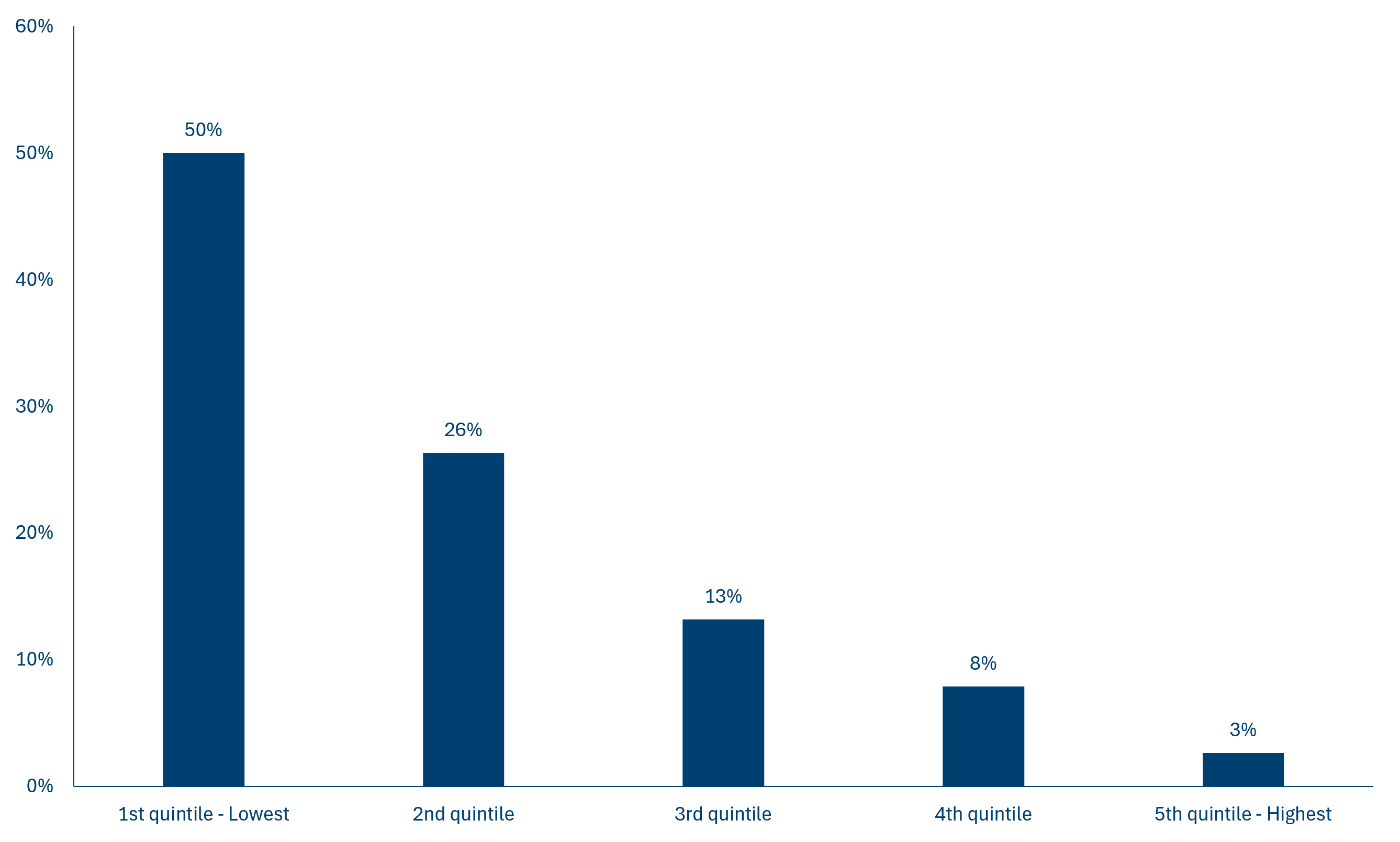
As a result of this activity, the chart below shows how cheap our holdings are relative to their own histories – nearly 80% of the portfolio trades below its historical median despite improved fundamentals. Against the constant commentary about how expensive some equities have become, many of our companies are bucking that trend. The prospective returns we hope to generate are a function of being willing to buy poor momentum stocks with positive fundamentals rather than compromising on quality.
Our holdings’ P/E history over the past 10 years |
 |
Source: Polar Capital and Bloomberg, 19 August 2026 |
Q: What do you think will be the catalyst for quality stocks to rerate?
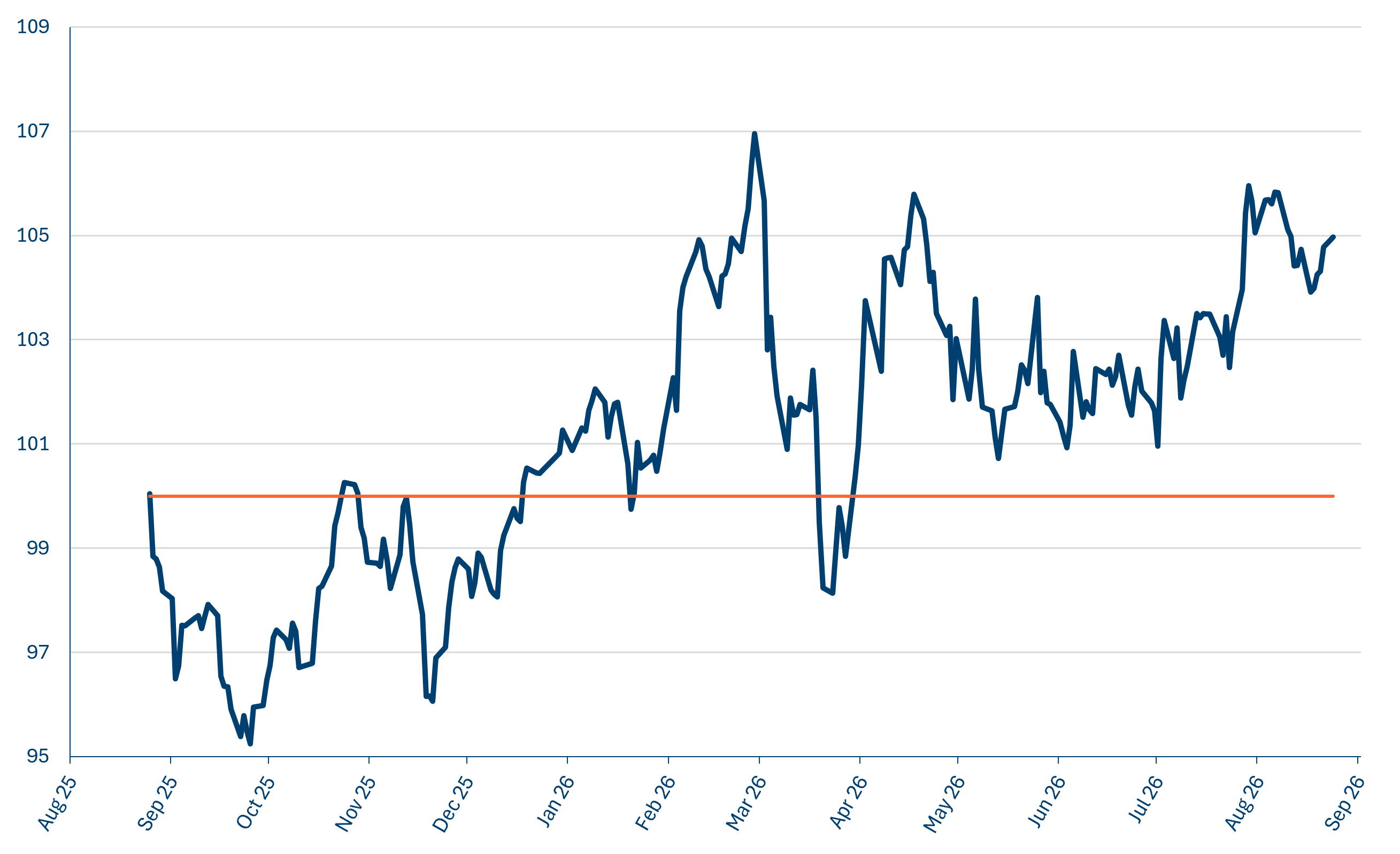
A: We think a lot of the quality stocks fit the criteria of owning hard assets with low risk of obsolescence (HALO) from AI disruption. Interestingly, these types of stock did quite well at the start of 2026, but this nascent recovery was disrupted by the market fallout from the conflict in the Middle East. As the chart below shows, our portfolio’s momentum has been improving over recent months after a brief hiatus around that conflict. We think the time to buy many of these stocks is now.
Price relative to 200-day moving average (past 12 months) |
 |
Source: Polar Capital and Bloomberg, 24 August 2026. Note: Portfolio weighted average price vs 200DMA (%) for the past 12 months. |
We see two clear catalysts for European quality stocks to do better – market context and earnings.
As July showed, the degree of market crowding in narrow thematics sets the scene for European quality to do better. European quality stocks are so under-owned (thanks to active quality fund outflows and passive inflows going elsewhere) that they should stand to benefit from any normalisation of risk-taking in markets. July gave a first indication of what that unwinding looks like. Having outperformed the broader market by 23 percentage points in 2026 to the end of June, high momentum stocks underperformed by 14 points in July alone. It was a global move rather than a European one, with the Philadelphia Semiconductor Index down 20.6%, the Korean KOSPI down 22.2% and the Taiwanese TAIEX down 6.5%, in local currency terms. One month is not a trend, but it is the first evidence that the crowding can reverse quickly when it unwinds.
The other catalyst is the improvement in European quality stocks’ earnings. We see the half year earnings season as very bullish. Twelve of our holdings raised full-year guidance at the Q2 stage: Siemens, DHL Group, Bureau Veritas, Veolia Environnement, FinecoBank, Getlink, Edenred, ENI, Orange, Kuehne & Nagel International, Publicis Groupe and Accor. Several of these companies saw AI-related selloffs in the first half of the year and are now producing strong results while setting out how they benefit from AI deployment in their own businesses. The delivery is happening, but the share prices have not yet reflected it.
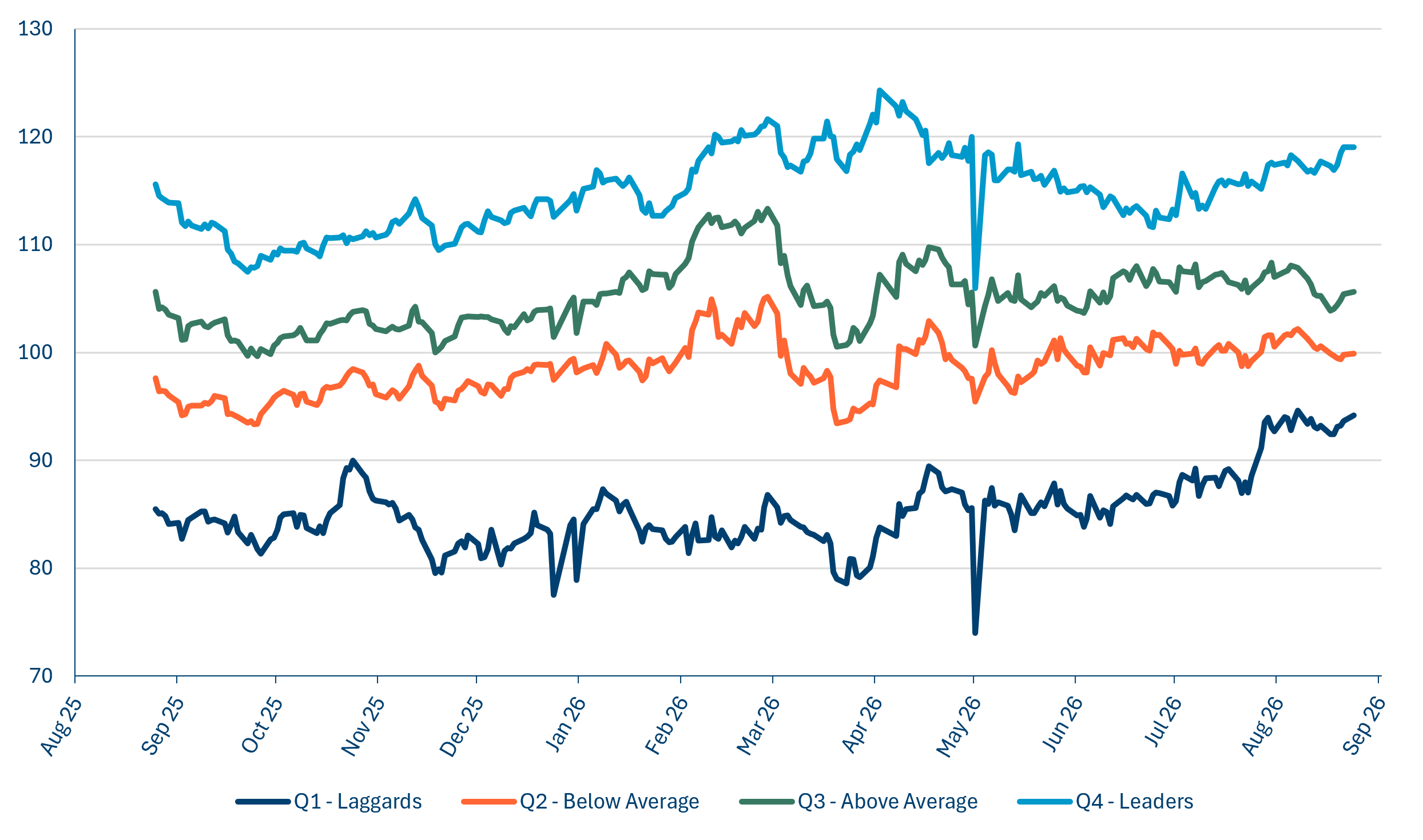
We can already see the early signs of this inside our own portfolio. Ranking every holding daily by how far its price sits above or below its 200-day moving average, the gap between the weakest and strongest quartiles has been wide for most of the past year. Since late July it has begun to close, and it is the laggards doing the work rather than the leaders rolling over. We would treat that as an observation about market breadth rather than a signal we trade on.
The portfolio has held above its 200-day average since February, and since late July the weakest quartile has closed around 10 points of the gap to the leaders.
| Dynamic daily quartile segmentation (Price vs 200DMA % for the past 12 months) |
 |
Source: Polar Capital and Bloomberg, 24 August 2026 |
We really like the chart below as an asset allocation tool. While it is not particularly good as a market timing tool, it does tell you where quality stocks are in their market cycle. Their underlying compounding characteristics mean they often deliver rolling five-year returns of at least high single digits. When their rolling five-year returns have dipped towards zero, as they have now, prospective returns tend to be much better. Another way of looking at this chart is to say it was right to sell ‘quality hubris’ in 2021 and points to it being right, if our interpretation is correct, to buy ‘quality humiliation’ in 2026.
Europe quality stocks set for a recovery |
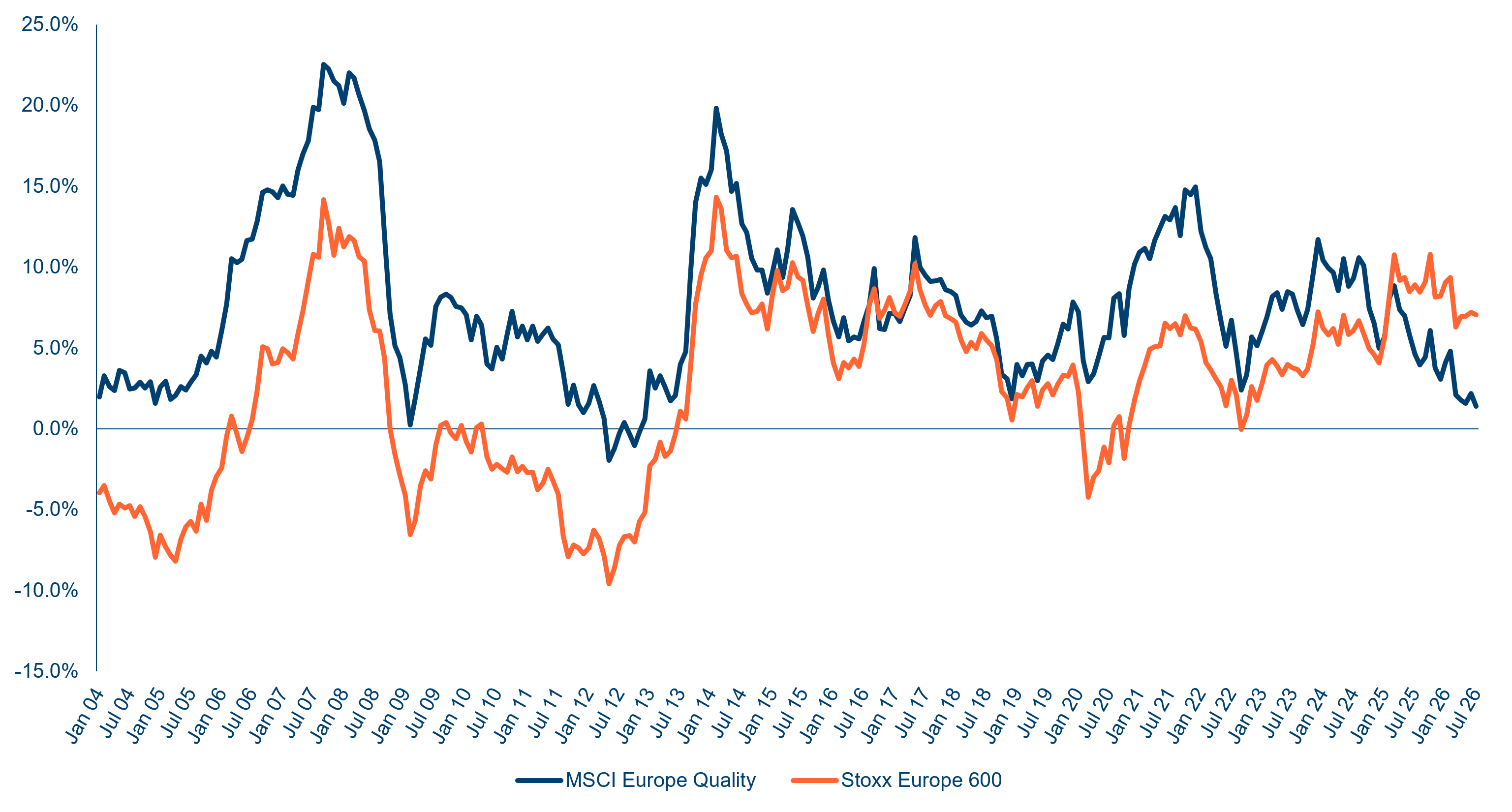 |
Source: Polar Capital and Bloomberg, 31 July 2026. Note: Rolling five-year total return for MSCI Europe Quality Index and Stoxx Europe 600 |
Q: Where does your Fund fit in a portfolio with significant exposure to US mega-cap technology companies?
A: The frequently cited lack of technology in Europe could easily go from headwind to tailwind in relative regional performance. Compare the 10 largest positions in the Fund with the 10 largest in the MSCI ACWI Index. There is no overlap at all in the names and very little overlap in what drives earnings.
Top 10 holdings: Fund versus MSCI All Country World Index |
 Source: Polar Capital, 27 August 2026 |
An investor adding our Fund is not buying a cheaper version of the same exposure. They are buying a different set of cashflows, at a different price, with a different sensitivity to the market.
None of that is an argument against owning those businesses. It is an argument against having all of your equity risk expressed through the same handful of them.