
In this article, we discuss our main takeaways from the US earnings season and why we remain upbeat on US banks.

Earnings estimates increased and we think they can go further

The recent results from US banks exceeded expectations as they announced stronger revenue growth that outpaced increased costs, while asset quality trends remained stable. Top-line growth expectations for banks increased on the back of a steeper yield curve1, helping net interest income and a strong pipeline in investment banking divisions that point to higher capital market2 fees.

CEO Todd Pick highlighted on the Morgan Stanley earnings call that: “Depending on how you measure it, whether volume or unit, you see pipelines in M&A that are the highest in seven years. So that is really encouraging. Now some of this will be dependent on how things roll in the first couple of months of the incoming administration and how things feel on a cross-border basis. But the pent-up activity that we’re seeing is starting to release.”

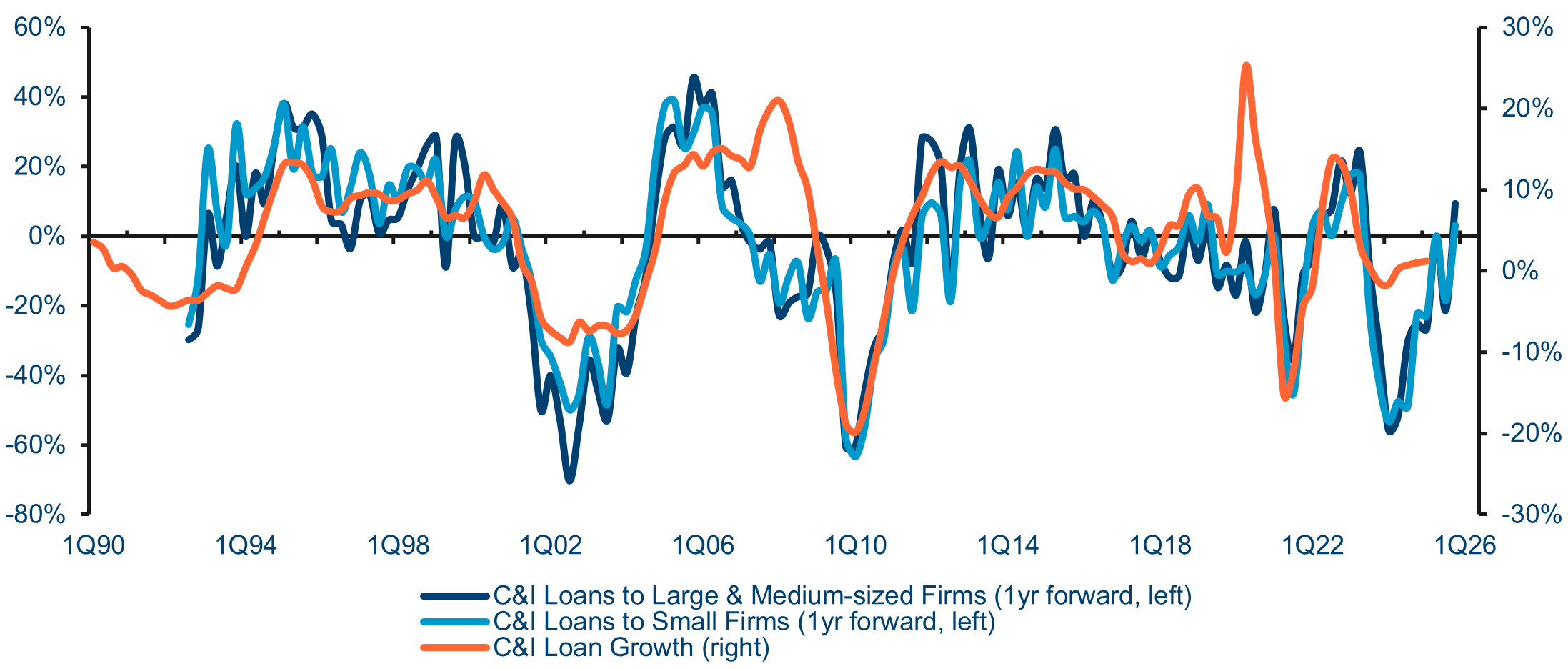
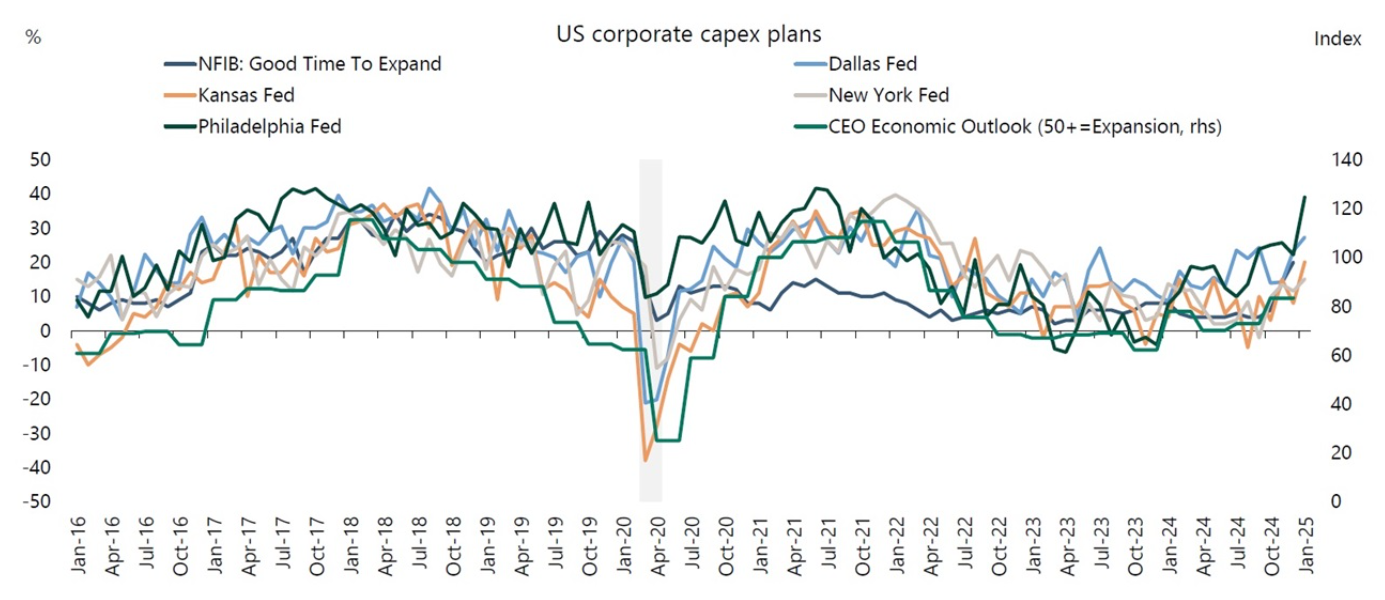
We believe further upside to estimates will be driven by loan growth, which has so far remained anaemic, as leading indicators start to turn positive. Recently released data from SLOOS (the Federal Reserve Senior Loan Officer Opinion Survey), showed an improvement in net demand for the first time in 11 quarters. Changes in demand in SLOOS tend to front-run industry loan growth (see chart below). Additionally, corporate capital expenditure (capex) spending plans are moving higher after the election. Both point to an upside to estimates.

Increasing loan growth
Increasing Loan Growth
Source: Barclays Research, Federal Reserve and FDIC


Corporate capex spending plans
Corporate Capex Spending Plans
Source: Growth is Accelerating3, Apollo Academy, February 2025


Deregulation: A new dawn

On 31 January, President Trump signed an executive order to "unleash prosperity through deregulation", requiring agencies to repeal 10 existing regulations for every new regulation.

Further underpinning the change in tone from the new administration, in a statement on his appointment the new Chairman of the Federal Deposit Insurance Corporation, one of the three main banking regulators in the US, stated that there would be a wholesale review of regulations to ensure its rules and approach would “promote a vibrant, growing economy”. Furthermore, the bank merger approval process would be improved to ensure that transactions satisfying the Bank Merger Act are approved in a “timely way”.

In February, Russell Vought, the acting head of the Consumer Financial Protection Bureau (CFPB), was reported by the Wall Street Journal to have issued a notice to staff demanding they “cease all supervision and examination activities”, not to issue any proposed or final rules or guidance and to suspend the effective dates of rules not yet effective. Trump has effectively shuttered the bureau and, at the time of writing, visitors to its website are greeted with a ‘Page not found’ message.

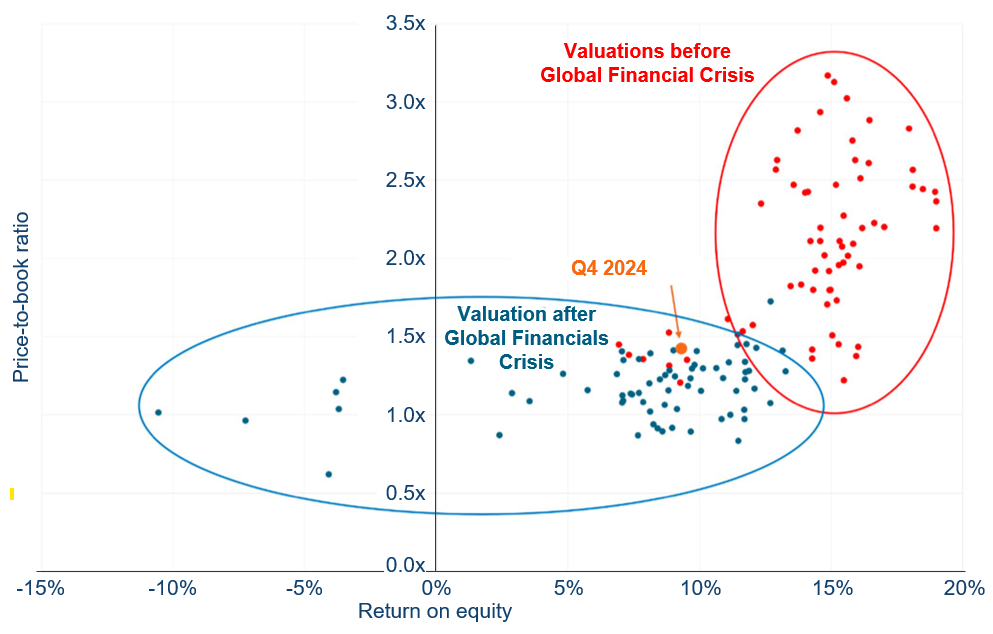
We see a reduction in regulation as a tailwind for the sector. Indeed, many investors will witness deregulation for the first time in their careers and might not fully appreciate the impact on banks. While most correctly assume deregulation will help capital, we also expect it to lead to lower regulatory costs (Wells Fargo Bank research estimates 20% of banks’ expenses are linked to compliance or other regulatory matters) and reduced concerns on fees (credit card late fees were the CFPB’s latest target) helping sentiment and therefore valuations.

Bank valuations
Bank Valuations
Source: Institutional Money, https://www.institutional-money.com/news/regulierung/headline/us-banken-stehen-dank-kuenftiger-deregulierung-vor-ihrem-comeback-238603, 16 January 2025. Note: This chart shows the valuation of US Financials before and after the Financial Crisis in 2007.  Following the Financial Crisis, regulation of US Financials increased significantly and we believe this was one of the key driver of lower valuations across the sector. 


Valuations remain undemanding

It is important to highlight US bank earnings are expected to grow in line with the S&P 500 and MSCI All Country World indices over the next two years yet they trade at a material discount. Given the undemanding valuation and our expectation of continued upside to estimates, we remain positive on US banks.

The Polar Capital Global Financials Trust has just under 20% invested in US banks and offers investors an attractive way to gain exposure to this key component of the US, perhaps global, economy.


P/E* (2026)EPS** estimated growth 2025EPS** estimated growth 2026
KBW Banks Index11.213%11%
S&P 500 Index20.014%12%
MSCI ACWI World Index16.911%12%
Source: Bloomberg; 12 February 2025; Notes: P/E* stands for price-to-earnings ratio, which relates a company's share price to its earnings per share (EPS**), a measure of a company’s value


1. Shows the yield on bonds over different terms to maturity

2. Equity and bond markets where individuals and companies go to raise and invest money

3. Growth Is Accelerating - Apollo Academy

Polar Capital Global Financials Trust plc (the "Company") The Company is an investment company with investment trust status and its shares are excluded from the Financial Conduct Authority’s (“FCA”) restrictions on the promotion of non-mainstream investment products. The Company conducts its affairs, and intends to continue to conduct its affairs, so that the exemption will apply.

The Company is an Alternative Investment Fund under the EU's Alternative Investment Fund Managers Directive 2011/61/EU as it forms part of UK law by virtue of the European Union (Withdrawal) Act 2018.

The Investment Manager: Polar Capital LLP is the investment manager of the Company (the "Investment Manager"). The Investment Manager is authorised and regulated by the FCA and is a registered investment adviser with the United States' Securities and Exchange Commission.

Key Risks

  • Investors' capital is at risk and there is no guarantee the Company will achieve its objective.
  • Past performance is not a reliable guide to future performance.
  • The value of investments may go down as well as up.
  • Investors might get back less than they originally invested.
  • The value of an investment’s assets may be affected by a variety of uncertainties such as (but not limited to): (i) international political developments; (ii) market sentiment; and (iii) economic conditions.
  • The shares of the Company may trade at a discount or a premium to Net Asset Value.
  • The Company may use derivatives which carry the risk of reduced liquidity, substantial loss and increased volatility in adverse market conditions.
  • The Company invests in assets denominated in currencies other than the Company's base currency and changes in exchange rates may have a negative impact on the value of the Company's investments.
  • The Company invests in a concentrated number of companies based in one sector. This focused strategy can lead to significant losses. The Company may be less diversified than other investment companies.
  • The Company may invest in emerging markets where there is a greater risk of volatility than developed economies, for example due to political and economic uncertainties and restrictions on foreign investment. Emerging markets are typically less liquid than developed economies which may result in large price movements to the Company.


Important Information

Not an offer to buy or sell: This document is not an offer to buy or sell or a solicitation of an offer to buy or sell any security, and under no circumstances is it to be construed as a prospectus or an advertisement. This document does not constitute, and may not be used for the purposes of, an offer of the securities of, or any interests in, the Company by any person in any jurisdiction in which such offer or invitation is not authorised.

Information subject to change: Any opinions expressed in this document may change.

Not Investment Advice: This document does not contain information material to the investment objectives or financial needs of the recipient. This document is not advice on legal, taxation or investment matters. Prospective investors must rely on their own examination of the consequences of an investment in the Company. Investors are advised to consult their own professional advisors concerning the investment.

No reliance: No reliance should be placed upon the contents of this document by any person for any purposes whatsoever. None of the Company, the Investment Manager or any of their respective affiliates accepts any responsibility for providing any investor with access to additional information, for revising or for correcting any inaccuracy in this document.

Performance and Holdings: All data is as at the document date unless indicated otherwise. Company holdings and performance are likely to have changed since the report date. Company information is provided by the Investment Manager.

Benchmark: The Company is actively managed and uses the MSCI ACWI Financials Net TR Index as a performance target.. The benchmark has been chosen as it is generally considered to be representative of the investment universe in which the Company invests. The performance of the Company is likely to differ from the performance of the benchmark as the holdings, weightings and asset allocation will be different. Investors should carefully consider these differences when making comparisons. Further information about the benchmark can be found here.

Third-party Data: Some information contained in this document has been obtained from third party sources and has not been independently verified. Neither the Company nor any other party involved in compiling, computing or creating the data makes any warranties or representations with respect to such data, and all such parties expressly disclaim all warranties of originality, accuracy, completeness, merchantability or fitness for a particular purpose with respect to any data contained within this document.

Country Specific Disclaimers

United States: The information contained within this document does not constitute or form a part of any offer to sell or issue, or the solicitation of any offer to purchase, subscribe for or otherwise acquire, any securities in the United States or in any jurisdiction in which such an offer or solicitation would be unlawful. The Company has not been and will not be registered under the United States Investment Company Act of 1940, as amended (the “Investment Company Act”) and, as such, the holders of its shares will not be entitled to the benefits of the Investment Company Act. In addition, the offer and sale of the Securities have not been, and will not be, registered under the U.S. Securities Act of 1933, as amended (the “Securities Act”). No Securities may be offered or sold or otherwise transacted within the United States or to, or for the account or benefit of U.S. Persons (as defined in Regulation S of the Securities Act). In connection with the transaction referred to in this document the shares of the Company will be offered and sold only outside the United States to, and for the account or benefit of non-U.S. Persons in “offshore- transactions” within the meaning of, and in reliance on the exemption from registration provided by Regulation S under the Securities Act. No money, securities or other consideration is being solicited and, if sent in response to the information contained in this document, will not be accepted. Any failure to comply with the above restrictions may constitute a violation of such securities laws.

Further Information about the Company: Investment in the Company is an investment in the shares of the Company and not in the underlying investments of the Company. Further information about the Company and any risks can be found in the Company’s Key Information Document, the Annual Report and Financial Statements and the Investor Disclosure Document which are available on the Company's website, found at:  https://www.polarcapitalglobalfinancialstrust.com

None

In this article, we discuss our main takeaways from the US earnings season and why we remain upbeat on US banks.

Earnings estimates increased and we think they can go further

The recent results from US banks exceeded expectations as they announced stronger revenue growth that outpaced increased costs, while asset quality trends remained stable. Top-line growth expectations for banks increased on the back of a steeper yield curve1, helping net interest income and a strong pipeline in investment banking divisions that point to higher capital market2 fees.

CEO Todd Pick highlighted on the Morgan Stanley earnings call that: “Depending on how you measure it, whether volume or unit, you see pipelines in M&A that are the highest in seven years. So that is really encouraging. Now some of this will be dependent on how things roll in the first couple of months of the incoming administration and how things feel on a cross-border basis. But the pent-up activity that we’re seeing is starting to release.”

We believe further upside to estimates will be driven by loan growth, which has so far remained anaemic, as leading indicators start to turn positive. Recently released data from SLOOS (the Federal Reserve Senior Loan Officer Opinion Survey), showed an improvement in net demand for the first time in 11 quarters. Changes in demand in SLOOS tend to front-run industry loan growth (see chart below). Additionally, corporate capital expenditure (capex) spending plans are moving higher after the election. Both point to an upside to estimates.

Increasing loan growth
Increasing Loan Growth
Source: Barclays Research, Federal Reserve and FDIC


Corporate capex spending plans
Corporate Capex Spending Plans
Source: Growth is Accelerating3, Apollo Academy, February 2025


Deregulation: A new dawn

On 31 January, President Trump signed an executive order to "unleash prosperity through deregulation", requiring agencies to repeal 10 existing regulations for every new regulation.

Further underpinning the change in tone from the new administration, in a statement on his appointment the new Chairman of the Federal Deposit Insurance Corporation, one of the three main banking regulators in the US, stated that there would be a wholesale review of regulations to ensure its rules and approach would “promote a vibrant, growing economy”. Furthermore, the bank merger approval process would be improved to ensure that transactions satisfying the Bank Merger Act are approved in a “timely way”.

In February, Russell Vought, the acting head of the Consumer Financial Protection Bureau (CFPB), was reported by the Wall Street Journal to have issued a notice to staff demanding they “cease all supervision and examination activities”, not to issue any proposed or final rules or guidance and to suspend the effective dates of rules not yet effective. Trump has effectively shuttered the bureau and, at the time of writing, visitors to its website are greeted with a ‘Page not found’ message.

We see a reduction in regulation as a tailwind for the sector. Indeed, many investors will witness deregulation for the first time in their careers and might not fully appreciate the impact on banks. While most correctly assume deregulation will help capital, we also expect it to lead to lower regulatory costs (Wells Fargo Bank research estimates 20% of banks’ expenses are linked to compliance or other regulatory matters) and reduced concerns on fees (credit card late fees were the CFPB’s latest target) helping sentiment and therefore valuations.

Bank valuations
Bank Valuations
Source: Institutional Money, https://www.institutional-money.com/news/regulierung/headline/us-banken-stehen-dank-kuenftiger-deregulierung-vor-ihrem-comeback-238603, 16 January 2025. Note: This chart shows the valuation of US Financials before and after the Financial Crisis in 2007.  Following the Financial Crisis, regulation of US Financials increased significantly and we believe this was one of the key driver of lower valuations across the sector. 


Valuations remain undemanding

It is important to highlight US bank earnings are expected to grow in line with the S&P 500 and MSCI All Country World indices over the next two years yet they trade at a material discount. Given the undemanding valuation and our expectation of continued upside to estimates, we remain positive on US banks.

The Polar Capital Global Financials Trust has just under 20% invested in US banks and offers investors an attractive way to gain exposure to this key component of the US, perhaps global, economy.


P/E* (2026)EPS** estimated growth 2025EPS** estimated growth 2026
KBW Banks Index11.213%11%
S&P 500 Index20.014%12%
MSCI ACWI World Index16.911%12%
Source: Bloomberg; 12 February 2025; Notes: P/E* stands for price-to-earnings ratio, which relates a company's share price to its earnings per share (EPS**), a measure of a company’s value


1. Shows the yield on bonds over different terms to maturity

2. Equity and bond markets where individuals and companies go to raise and invest money

3. Growth Is Accelerating - Apollo Academy

Related Fund

Polar Capital Global Financials Trust plc (the "Company") The Company is an investment company with investment trust status and its shares are excluded from the Financial Conduct Authority’s (“FCA”) restrictions on the promotion of non-mainstream investment products. The Company conducts its affairs, and intends to continue to conduct its affairs, so that the exemption will apply.

The Company is an Alternative Investment Fund under the EU's Alternative Investment Fund Managers Directive 2011/61/EU as it forms part of UK law by virtue of the European Union (Withdrawal) Act 2018.

The Investment Manager: Polar Capital LLP is the investment manager of the Company (the "Investment Manager"). The Investment Manager is authorised and regulated by the FCA and is a registered investment adviser with the United States' Securities and Exchange Commission.

Key Risks

  • Investors' capital is at risk and there is no guarantee the Company will achieve its objective.
  • Past performance is not a reliable guide to future performance.
  • The value of investments may go down as well as up.
  • Investors might get back less than they originally invested.
  • The value of an investment’s assets may be affected by a variety of uncertainties such as (but not limited to): (i) international political developments; (ii) market sentiment; and (iii) economic conditions.
  • The shares of the Company may trade at a discount or a premium to Net Asset Value.
  • The Company may use derivatives which carry the risk of reduced liquidity, substantial loss and increased volatility in adverse market conditions.
  • The Company invests in assets denominated in currencies other than the Company's base currency and changes in exchange rates may have a negative impact on the value of the Company's investments.
  • The Company invests in a concentrated number of companies based in one sector. This focused strategy can lead to significant losses. The Company may be less diversified than other investment companies.
  • The Company may invest in emerging markets where there is a greater risk of volatility than developed economies, for example due to political and economic uncertainties and restrictions on foreign investment. Emerging markets are typically less liquid than developed economies which may result in large price movements to the Company.


Important Information

Not an offer to buy or sell: This document is not an offer to buy or sell or a solicitation of an offer to buy or sell any security, and under no circumstances is it to be construed as a prospectus or an advertisement. This document does not constitute, and may not be used for the purposes of, an offer of the securities of, or any interests in, the Company by any person in any jurisdiction in which such offer or invitation is not authorised.

Information subject to change: Any opinions expressed in this document may change.

Not Investment Advice: This document does not contain information material to the investment objectives or financial needs of the recipient. This document is not advice on legal, taxation or investment matters. Prospective investors must rely on their own examination of the consequences of an investment in the Company. Investors are advised to consult their own professional advisors concerning the investment.

No reliance: No reliance should be placed upon the contents of this document by any person for any purposes whatsoever. None of the Company, the Investment Manager or any of their respective affiliates accepts any responsibility for providing any investor with access to additional information, for revising or for correcting any inaccuracy in this document.

Performance and Holdings: All data is as at the document date unless indicated otherwise. Company holdings and performance are likely to have changed since the report date. Company information is provided by the Investment Manager.

Benchmark: The Company is actively managed and uses the MSCI ACWI Financials Net TR Index as a performance target.. The benchmark has been chosen as it is generally considered to be representative of the investment universe in which the Company invests. The performance of the Company is likely to differ from the performance of the benchmark as the holdings, weightings and asset allocation will be different. Investors should carefully consider these differences when making comparisons. Further information about the benchmark can be found here.

Third-party Data: Some information contained in this document has been obtained from third party sources and has not been independently verified. Neither the Company nor any other party involved in compiling, computing or creating the data makes any warranties or representations with respect to such data, and all such parties expressly disclaim all warranties of originality, accuracy, completeness, merchantability or fitness for a particular purpose with respect to any data contained within this document.

Country Specific Disclaimers

United States: The information contained within this document does not constitute or form a part of any offer to sell or issue, or the solicitation of any offer to purchase, subscribe for or otherwise acquire, any securities in the United States or in any jurisdiction in which such an offer or solicitation would be unlawful. The Company has not been and will not be registered under the United States Investment Company Act of 1940, as amended (the “Investment Company Act”) and, as such, the holders of its shares will not be entitled to the benefits of the Investment Company Act. In addition, the offer and sale of the Securities have not been, and will not be, registered under the U.S. Securities Act of 1933, as amended (the “Securities Act”). No Securities may be offered or sold or otherwise transacted within the United States or to, or for the account or benefit of U.S. Persons (as defined in Regulation S of the Securities Act). In connection with the transaction referred to in this document the shares of the Company will be offered and sold only outside the United States to, and for the account or benefit of non-U.S. Persons in “offshore- transactions” within the meaning of, and in reliance on the exemption from registration provided by Regulation S under the Securities Act. No money, securities or other consideration is being solicited and, if sent in response to the information contained in this document, will not be accepted. Any failure to comply with the above restrictions may constitute a violation of such securities laws.

Further Information about the Company: Investment in the Company is an investment in the shares of the Company and not in the underlying investments of the Company. Further information about the Company and any risks can be found in the Company’s Key Information Document, the Annual Report and Financial Statements and the Investor Disclosure Document which are available on the Company's website, found at:  https://www.polarcapitalglobalfinancialstrust.com