



We expect ongoing consolidation in the healthcare industry, which remains highly fragmented. Structural pressures, technological innovations, attractive valuations and an unprecedented wave of patent expiries are converging to drive merger and acquisition (M&A) activity across the sector. For healthcare investors, consolidation has the potential to support both earnings growth and shareholder returns.
The patent ‘cliff’
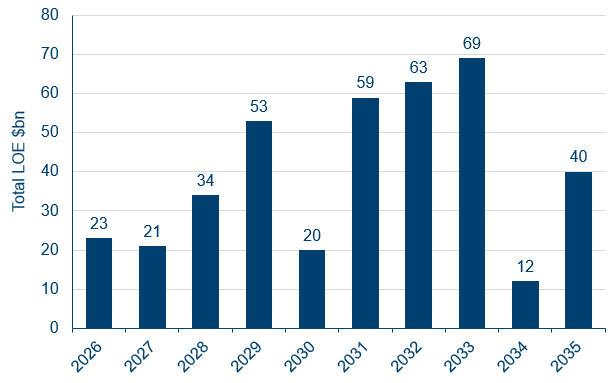
One of the most important factors driving M&A is that large pharmaceutical companies are facing the biggest patent ‘cliff’ seen in the history of the industry. Between 2025 and 2030, over $150bn of product revenues are facing patent expiry – loss of exclusivity – at which point they can be replaced by cheaper generic drugs. This represents 20% of total industry revenues and is a major incentive for large pharmaceutical companies to look for acquisitions, particularly of biotech companies with late-stage products that are close to being marketed.
| Total large-cap patent expiry exposure by year, 2026-2035 |
 |
| Source: Company disclosure, VA consensus, Leerink Partners, 12 January 2026. |
After 2030, the situation still looks painful for the major pharmaceutical companies. As things stand, 50% of AstraZeneca’s revenues and 31% of GSK’s will be subject to generic competition. For management teams, the implications are clear. To maintain revenue growth, they must replenish pipelines and diversify revenue streams. Historically, this has been achieved through a combination of internal R&D, licensing assets from academia or smaller companies, and – crucially – acquisitions. Given the magnitude of the coming revenue gap, we expect external innovation to play an increasingly important role.
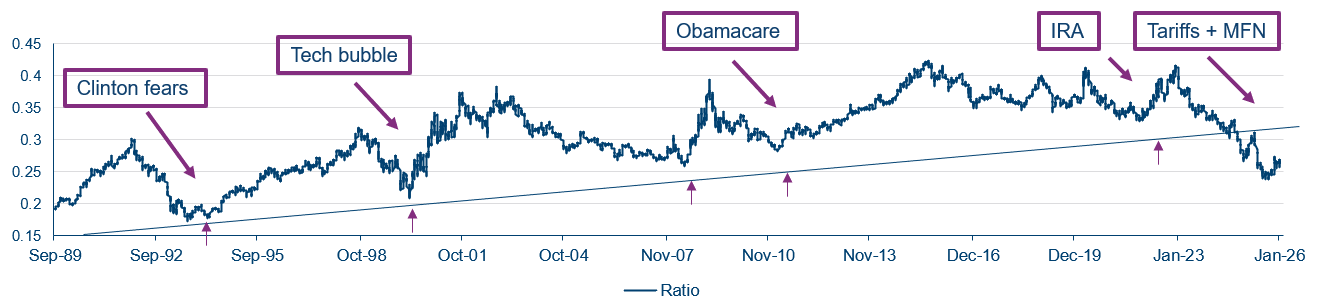
After a period of relative caution, the final months of 2025 saw a marked pick-up in M&A activity. Earlier in the year, sentiment had been shaped by the triple threat of tariff concerns, drug pricing pressures and regulatory uncertainty. These factors weighed heavily on healthcare valuations, creating attractive opportunities for investors and industry buyers.
S&P 500 Healthcare Index vs S&P 500 Index |
 |
| Source: Polar Capital, Bloomberg 27 February 2026. |
In the final quarter of the year, these concerns started to lift when tariff worries lessened, and major pharma companies struck deals with the US government over ‘most favoured nation’ pricing. Cash rich pharmaceutical companies, made more confident by the more attractive tariff and pricing environment, were able to take advantage of cheap biotech valuations. As a result, the scale of biopharma mergers and acquisitions in the fourth quarter came close to $95bn1.
To give a few examples, Novartis bought California-based Avidity Biosciences, a muscular dystrophy specialist, for $12bn. Novartis bought Avidity to own breakthrough delivery technology, acquire near-term assets addressing serious genetic diseases, drive growth in RNA-based medicines, and enhance its neuroscience and rare disease strategy. Subsequently, elements of the acquired business were spun out as Atrium Therapeutics, showing how strategic deals can create additional value.
Elsewhere, Merck acquired Cidara, Sanofi bought Dynavax, and Genmab acquired Merus. These transactions span therapeutic areas and geographies, but share a common theme: targeted acquisitions designed to address specific pipeline needs and enhance long-term growth prospects.
Creating value for investors
For investors, M&A has been a meaningful driver of returns. Takeover premiums in healthcare are often substantial, with premiums of more than 50% to the pre-announcement share price not uncommon:
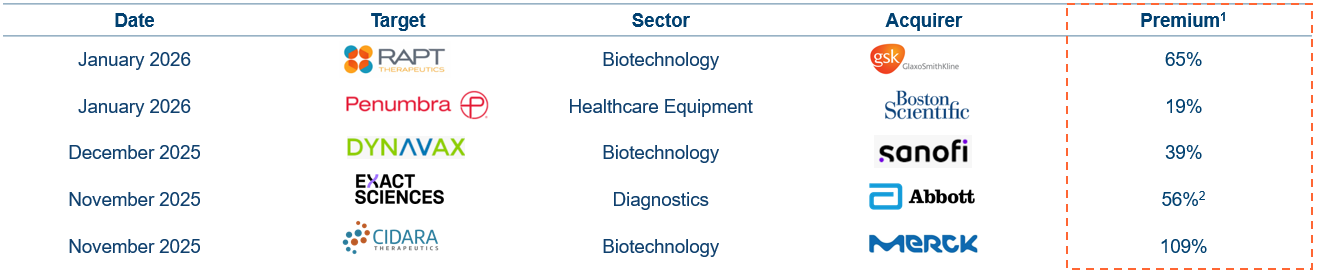 |
| Past performance is not indicative or a guarantee of future results. Source: Bloomberg, January 2026 – public to public companies, 1. Based on prior day closing share price unless otherwise stated, 2. Based on prior day closing share price to the initial public disclosure of potential transaction. |
Importantly, consolidation can also be positive for acquirers. When transactions are strategically coherent and financially disciplined, we expect the market to reward buyers.
Cheap valuations and strong fundamentals
Sector valuations remain supportive. Periods of political controversy, tariff rhetoric and regulatory uncertainty have left parts of healthcare trading at discounts to historical averages. Yet underlying fundamentals – scientific innovation, demographic demand, and resilient end-markets – remain intact.
In this context, consolidation serves as both a catalyst and a validation of value. Strategic buyers are effectively signalling confidence in long-term growth prospects by committing capital at scale.
1. Source: Biomedtracker 5 February 2026.