The global economy is entering a more complex phase. Interest rates are no longer anchored near zero. Governments are deploying fiscal policy more actively. Capital investment – in infrastructure, energy security, defence and digital capacity – is rising in strategic importance.

Financial companies sit at the centre of these shifts. They intermediate savings, allocate capital, underwrite risk and facilitate transactions. When the economic regime changes, the transmission mechanism runs directly through the financial system.

After a prolonged period defined by ultra-low interest rates and cautious balance sheet management, the financials sector today is operating in an environment in which capital generation and productivity gains may become more important drivers of returns.

The war in the Middle East is a reminder that this evolving economic backdrop is unlikely to be linear. It has contributed to higher energy prices and increased market volatility, reinforcing the importance of resilient balance sheets and disciplined capital allocation across the financial system.

We are liable to continue to see periods of uncertainty such as this and the impact it has on nearer-term growth and inflation. However, our focus is very much on the longer-term structural drivers, discussed below, that remain intact.

Normalised rates and capital discipline

For much of the previous decade, interest rates in developed markets were exceptionally low. That contributed to compressed margins in parts of the banking system and distorted the pricing of risk across asset classes.

A more normalised interest rate backdrop changes the equation. Banks are better able to earn appropriate spreads on deposits and loans. Insurers can reinvest premiums at more attractive yields. Savers once again receive compensation for capital. Risk is more explicitly priced.

This does not eliminate risk. Higher rates can expose weaker borrowers and create credit stress if growth slows. However, from a structural perspective, the financial system is operating in a more economically rational framework than during the zero-rate era.

At the same time, fiscal policy is becoming more active. Public investment initiatives require financing and private sector capital expenditure is responding to shifting geopolitical and supply chain realities. A well-capitalised and functioning financial system is essential to supporting that activity.

Regulatory recalibration

The financial system is entering this phase from a position of strength. Over the past decade, capital levels have risen materially and supervisory oversight has remained rigorous. Balance sheets are much more conservative and liquidity buffers higher than in previous cycles.

More recently, policymakers in parts of the US and Europe have begun to discuss whether elements of the regulatory framework can be simplified without compromising stability. In the US, proposals under discussion would allow large banks greater flexibility in returning capital to shareholders, supporting loan growth and improving capital efficiency. In Europe, there is growing focus on simplification and consolidation to enhance competitiveness.

This is not a wholesale loosening of safeguards. Rather, it reflects recognition that regulatory regimes can accumulate complexity over time. For investors, improved capital efficiency – if delivered prudently – can support stronger returns on equity while preserving resilience.

A broad and differentiated sector

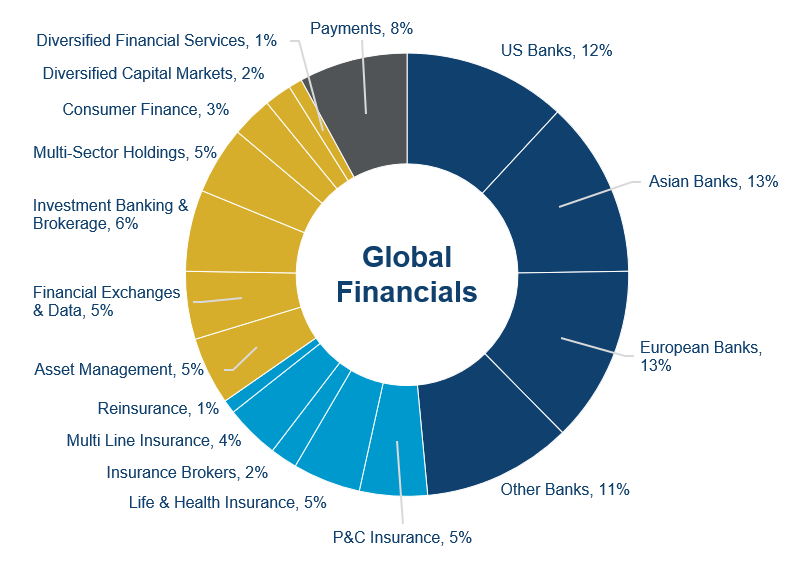
Financials are the second largest sector within global equity markets and encompass a wide range of business models.

Composition Of Global Financials
Source: MSCI, 30 January 2026.


Banks are one component, but insurers, exchanges, trading platforms, asset managers and specialist lenders each have distinct earnings drivers. Life insurers benefit from demographic and savings trends. Exchanges and platforms can benefit from elevated market activity. Asset managers are leveraged to flows and equity markets. Emerging market lenders operate in economies where financial penetration continues to deepen.

These subsectors respond differently to interest rates, growth, inflation and volatility. The diversity of drivers within financials allows for differentiated sources of return across the cycle.

In certain regions, particularly Europe, valuations remain at discounts relative to broader equity markets despite improved profitability. While valuation alone is not a catalyst, it can provide a degree of support if earnings remain disciplined and capital allocation rational.

Productivity and technology

Technological advancement is another important structural factor. Artificial intelligence and advanced data analytics are reshaping many industries. Earlier this year, concerns about disruption contributed to volatility across parts of the financial sector.

However, financial services are inherently data-rich and process-intensive. Credit assessment, fraud detection, compliance monitoring and customer servicing are areas where automation can enhance efficiency and accuracy. Several institutions have cited tangible productivity gains and medium-term return targets supported by technology adoption.

External research suggests that banking and insurance are among the sectors most exposed to productivity improvements from AI deployment. For well-capitalised incumbents, scale and data depth can be competitive advantages.

Rather than displacing established institutions, technology may reinforce the operating leverage of those able to implement it effectively.

Capital allocation and income

Financial companies are significant generators of cashflow. When capital buffers are comfortably above regulatory minimums, this can support dividends and, where appropriate, share buybacks.

The Polar Capital Global Financials Trust operates an enhanced dividend policy targeting a 4% annual distribution, paid quarterly. While dividends are not guaranteed and may be reduced in adverse market conditions, capital discipline remains central to our approach.

The Trust invests across the global financials universe, including banks, insurers, payment companies, exchanges and asset managers. Approximately 40% of the portfolio is currently invested in US and European banks, reflecting our view that many of these institutions combine strong balance sheets with improving capital efficiency and exposure to evolving macro conditions.

Active management is essential in a sector shaped by economic cycles, regulatory change and subsector rotation. Within the portfolio, we balance exposure to US banks benefiting from regulatory recalibration, European banks trading at valuation discounts, insurers positioned for long-term savings growth and platforms that can benefit from elevated market activity. This diversified positioning reflects our view that different parts of the sector will lead at different stages of the cycle.

Positioned for the next phase

The defining features of the previous era – ultra-low rates, subdued credit growth and continual regulatory tightening – are evolving. Today our investment world is characterised by stronger balance sheets, normalised interest rates, more active fiscal policy and regulatory recalibration.

Financials will not deliver returns in a straight line. Cyclical setbacks are inevitable, and periods of volatility should be expected. However, the sector’s central role in capital formation – combined with improved resilience, disciplined underwriting and more efficient capital allocation – suggests it is positioned differently for the phase ahead.

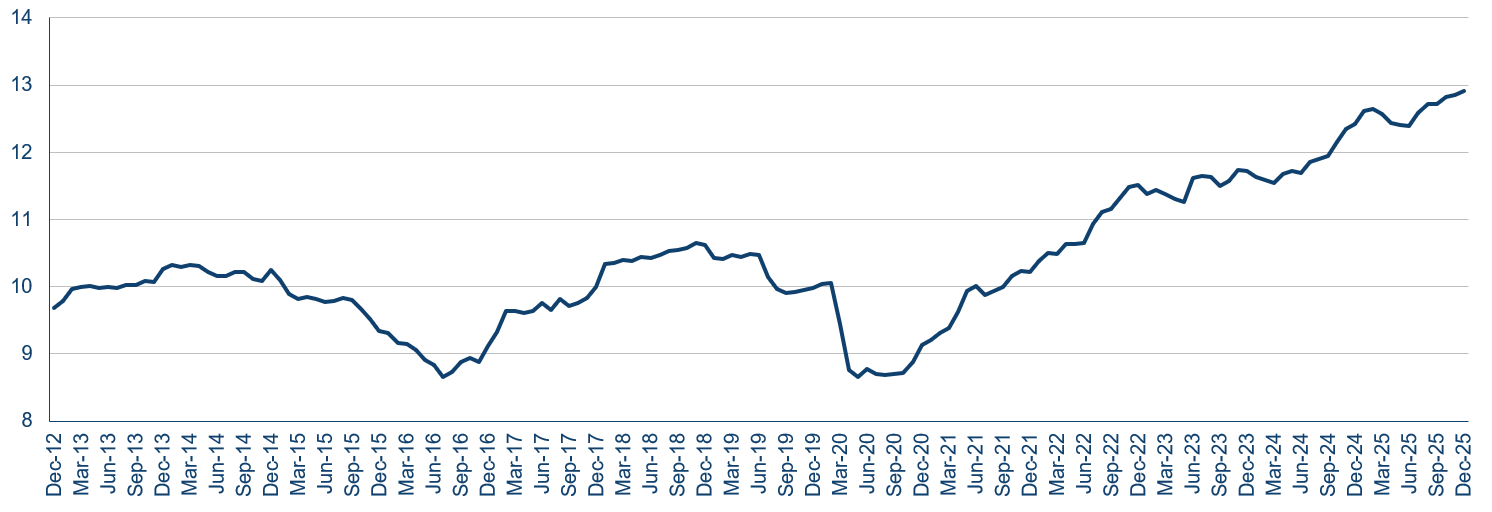
The graph below shows that financial companies are becoming more profitable, with their return on equity – a measure of how efficiently companies generate profits – has improved significantly.

Financials delivering stronger returns (%)
Return On Equity Of The Sector Has Improved Significantly
Source: Polar Capital, Bloomberg, 31 December 2025. Note: Return on Equity shown for the benchmark; MSCI All Country World Index Financials Index.


For the Trust, this aligns closely with how the portfolio is constructed. We focus on well-capitalised institutions with durable franchises, prudent risk cultures and the ability to generate attractive returns across the cycle. Our exposure to US and European banks reflects our view that capital efficiency and regulatory evolution can support sustainable profitability, while our holdings across insurers, exchanges and asset managers provide differentiated earnings drivers within the broader financial ecosystem.

In our view, the sector today combines three features that rarely coincide: structural resilience, improving capital dynamics and supportive macroeconomic conditions. That does not eliminate risk, but it does create a more constructive foundation than has existed for much of the past decade. The sector’s return on equity has improved materially over recent years, reflecting both stronger balance sheets and more disciplined capital allocation. For long-term investors willing to accept cyclical variability, we believe financials – and active exposure to them through a specialist strategy – offer a compelling opportunity as the economic regime continues to evolve.


The Company is an investment company with investment trust status and its shares are excluded from the Financial Conduct Authority’s (“FCA”) restrictions on the promotion of non-mainstream investment products. The Company conducts its affairs, and intends to continue to conduct its affairs, so that the exemption will apply.

The Company is an Alternative Investment Fund under the EU's Alternative Investment Fund Managers Directive 2011/61/EU as it forms part of UK law by virtue of the European Union (Withdrawal) Act 2018.

The Investment Manager: Polar Capital LLP is the investment manager of the Company (the "Investment Manager"). The Investment Manager is authorised and regulated by the FCA and is a registered investment adviser with the United States' Securities and Exchange Commission.

Key Risks

  • Investors' capital is at risk and there is no guarantee the Company will achieve its objective.
  • Past performance is not a reliable guide to future performance.
  • The value of investments may go down as well as up.
  • Investors might get back less than they originally invested.
  • The value of an investment’s assets may be affected by a variety of uncertainties such as (but not limited to): (i) international political developments; (ii) market sentiment; and (iii) economic conditions.
  • The shares of the Company may trade at a discount or a premium to Net Asset Value.
  • The Company may use derivatives which carry the risk of reduced liquidity, substantial loss and increased volatility in adverse market conditions.
  • The Company invests in assets denominated in currencies other than the Company's base currency and changes in exchange rates may have a negative impact on the value of the Company's investments.
  • The Company invests in a concentrated number of companies based in one sector. This focused strategy can lead to significant losses. The Company may be less diversified than other investment companies.
  • The Company may invest in emerging markets where there is a greater risk of volatility than developed economies, for example due to political and economic uncertainties and restrictions on foreign investment. Emerging markets are typically less liquid than developed economies which may result in large price movements to the Company.


Important Information

Not an offer to buy or sell: This document is not an offer to buy or sell or a solicitation of an offer to buy or sell any security, and under no circumstances is it to be construed as a prospectus or an advertisement. This document does not constitute, and may not be used for the purposes of, an offer of the securities of, or any interests in, the Company by any person in any jurisdiction in which such offer or invitation is not authorised.

Information subject to change: Any opinions expressed in this document may change.

Not Investment Advice: This document does not contain information material to the investment objectives or financial needs of the recipient. This document is not advice on legal, taxation or investment matters. Prospective investors must rely on their own examination of the consequences of an investment in the Company. Investors are advised to consult their own professional advisors concerning the investment.

No reliance:No reliance should be placed upon the contents of this document by any person for any purposes whatsoever. None of the Company, the Investment Manager or any of their respective affiliates accepts any responsibility for providing any investor with access to additional information, for revising or for correcting any inaccuracy in this document.

Performance and Holdings: All data is as at the document date unless indicated otherwise. Company holdings and performance are likely to have changed since the report date. Company information is provided by the Investment Manager.

Benchmark: The Company is actively managed and uses the MSCI ACWI Financials Net TR Index as a performance target.. The benchmark has been chosen as it is generally considered to be representative of the investment universe in which the Company invests. The performance of the Company is likely to differ from the performance of the benchmark as the holdings, weightings and asset allocation will be different. Investors should carefully consider these differences when making comparisons. Further information about the benchmark can be found here.

Third-party Data: Some information contained in this document has been obtained from third party sources and has not been independently verified. Neither the Company nor any other party involved in compiling, computing or creating the data makes any warranties or representations with respect to such data, and all such parties expressly disclaim all warranties of originality, accuracy, completeness, merchantability or fitness for a particular purpose with respect to any data contained within this document.

Country Specific Disclaimers

United States: The information contained within this document does not constitute or form a part of any offer to sell or issue, or the solicitation of any offer to purchase, subscribe for or otherwise acquire, any securities in the United States or in any jurisdiction in which such an offer or solicitation would be unlawful. The Company has not been and will not be registered under the United States Investment Company Act of 1940, as amended (the “Investment Company Act”) and, as such, the holders of its shares will not be entitled to the benefits of the Investment Company Act. In addition, the offer and sale of the Securities have not been, and will not be, registered under the U.S. Securities Act of 1933, as amended (the “Securities Act”). No Securities may be offered or sold or otherwise transacted within the United States or to, or for the account or benefit of U.S. Persons (as defined in Regulation S of the Securities Act). In connection with the transaction referred to in this document the shares of the Company will be offered and sold only outside the United States to, and for the account or benefit of non-U.S. Persons in “offshore- transactions” within the meaning of, and in reliance on the exemption from registration provided by Regulation S under the Securities Act. No money, securities or other consideration is being solicited and, if sent in response to the information contained in this document, will not be accepted. Any failure to comply with the above restrictions may constitute a violation of such securities laws.

Further Information about the Company: Investment in the Company is an investment in the shares of the Company and not in the underlying investments of the Company. Further information about the Company and any risks can be found in the Company’s Key Information Document, the Annual Report and Financial Statements and the Investor Disclosure Document which are available on the Company's website, found at: https://www.polarcapitalglobalfinancialstrust.com.

None

The global economy is entering a more complex phase. Interest rates are no longer anchored near zero. Governments are deploying fiscal policy more actively. Capital investment – in infrastructure, energy security, defence and digital capacity – is rising in strategic importance.

Financial companies sit at the centre of these shifts. They intermediate savings, allocate capital, underwrite risk and facilitate transactions. When the economic regime changes, the transmission mechanism runs directly through the financial system.

After a prolonged period defined by ultra-low interest rates and cautious balance sheet management, the financials sector today is operating in an environment in which capital generation and productivity gains may become more important drivers of returns.

The war in the Middle East is a reminder that this evolving economic backdrop is unlikely to be linear. It has contributed to higher energy prices and increased market volatility, reinforcing the importance of resilient balance sheets and disciplined capital allocation across the financial system.

We are liable to continue to see periods of uncertainty such as this and the impact it has on nearer-term growth and inflation. However, our focus is very much on the longer-term structural drivers, discussed below, that remain intact.

Normalised rates and capital discipline

For much of the previous decade, interest rates in developed markets were exceptionally low. That contributed to compressed margins in parts of the banking system and distorted the pricing of risk across asset classes.

A more normalised interest rate backdrop changes the equation. Banks are better able to earn appropriate spreads on deposits and loans. Insurers can reinvest premiums at more attractive yields. Savers once again receive compensation for capital. Risk is more explicitly priced.

This does not eliminate risk. Higher rates can expose weaker borrowers and create credit stress if growth slows. However, from a structural perspective, the financial system is operating in a more economically rational framework than during the zero-rate era.

At the same time, fiscal policy is becoming more active. Public investment initiatives require financing and private sector capital expenditure is responding to shifting geopolitical and supply chain realities. A well-capitalised and functioning financial system is essential to supporting that activity.

Regulatory recalibration

The financial system is entering this phase from a position of strength. Over the past decade, capital levels have risen materially and supervisory oversight has remained rigorous. Balance sheets are much more conservative and liquidity buffers higher than in previous cycles.

More recently, policymakers in parts of the US and Europe have begun to discuss whether elements of the regulatory framework can be simplified without compromising stability. In the US, proposals under discussion would allow large banks greater flexibility in returning capital to shareholders, supporting loan growth and improving capital efficiency. In Europe, there is growing focus on simplification and consolidation to enhance competitiveness.

This is not a wholesale loosening of safeguards. Rather, it reflects recognition that regulatory regimes can accumulate complexity over time. For investors, improved capital efficiency – if delivered prudently – can support stronger returns on equity while preserving resilience.

A broad and differentiated sector

Financials are the second largest sector within global equity markets and encompass a wide range of business models.

Composition Of Global Financials
Source: MSCI, 30 January 2026.


Banks are one component, but insurers, exchanges, trading platforms, asset managers and specialist lenders each have distinct earnings drivers. Life insurers benefit from demographic and savings trends. Exchanges and platforms can benefit from elevated market activity. Asset managers are leveraged to flows and equity markets. Emerging market lenders operate in economies where financial penetration continues to deepen.

These subsectors respond differently to interest rates, growth, inflation and volatility. The diversity of drivers within financials allows for differentiated sources of return across the cycle.

In certain regions, particularly Europe, valuations remain at discounts relative to broader equity markets despite improved profitability. While valuation alone is not a catalyst, it can provide a degree of support if earnings remain disciplined and capital allocation rational.

Productivity and technology

Technological advancement is another important structural factor. Artificial intelligence and advanced data analytics are reshaping many industries. Earlier this year, concerns about disruption contributed to volatility across parts of the financial sector.

However, financial services are inherently data-rich and process-intensive. Credit assessment, fraud detection, compliance monitoring and customer servicing are areas where automation can enhance efficiency and accuracy. Several institutions have cited tangible productivity gains and medium-term return targets supported by technology adoption.

External research suggests that banking and insurance are among the sectors most exposed to productivity improvements from AI deployment. For well-capitalised incumbents, scale and data depth can be competitive advantages.

Rather than displacing established institutions, technology may reinforce the operating leverage of those able to implement it effectively.

Capital allocation and income

Financial companies are significant generators of cashflow. When capital buffers are comfortably above regulatory minimums, this can support dividends and, where appropriate, share buybacks.

The Polar Capital Global Financials Trust operates an enhanced dividend policy targeting a 4% annual distribution, paid quarterly. While dividends are not guaranteed and may be reduced in adverse market conditions, capital discipline remains central to our approach.

The Trust invests across the global financials universe, including banks, insurers, payment companies, exchanges and asset managers. Approximately 40% of the portfolio is currently invested in US and European banks, reflecting our view that many of these institutions combine strong balance sheets with improving capital efficiency and exposure to evolving macro conditions.

Active management is essential in a sector shaped by economic cycles, regulatory change and subsector rotation. Within the portfolio, we balance exposure to US banks benefiting from regulatory recalibration, European banks trading at valuation discounts, insurers positioned for long-term savings growth and platforms that can benefit from elevated market activity. This diversified positioning reflects our view that different parts of the sector will lead at different stages of the cycle.

Positioned for the next phase

The defining features of the previous era – ultra-low rates, subdued credit growth and continual regulatory tightening – are evolving. Today our investment world is characterised by stronger balance sheets, normalised interest rates, more active fiscal policy and regulatory recalibration.

Financials will not deliver returns in a straight line. Cyclical setbacks are inevitable, and periods of volatility should be expected. However, the sector’s central role in capital formation – combined with improved resilience, disciplined underwriting and more efficient capital allocation – suggests it is positioned differently for the phase ahead.

The graph below shows that financial companies are becoming more profitable, with their return on equity – a measure of how efficiently companies generate profits – has improved significantly.

Financials delivering stronger returns (%)
Return On Equity Of The Sector Has Improved Significantly
Source: Polar Capital, Bloomberg, 31 December 2025. Note: Return on Equity shown for the benchmark; MSCI All Country World Index Financials Index.


For the Trust, this aligns closely with how the portfolio is constructed. We focus on well-capitalised institutions with durable franchises, prudent risk cultures and the ability to generate attractive returns across the cycle. Our exposure to US and European banks reflects our view that capital efficiency and regulatory evolution can support sustainable profitability, while our holdings across insurers, exchanges and asset managers provide differentiated earnings drivers within the broader financial ecosystem.

In our view, the sector today combines three features that rarely coincide: structural resilience, improving capital dynamics and supportive macroeconomic conditions. That does not eliminate risk, but it does create a more constructive foundation than has existed for much of the past decade. The sector’s return on equity has improved materially over recent years, reflecting both stronger balance sheets and more disciplined capital allocation. For long-term investors willing to accept cyclical variability, we believe financials – and active exposure to them through a specialist strategy – offer a compelling opportunity as the economic regime continues to evolve.

Related Fund

The Company is an investment company with investment trust status and its shares are excluded from the Financial Conduct Authority’s (“FCA”) restrictions on the promotion of non-mainstream investment products. The Company conducts its affairs, and intends to continue to conduct its affairs, so that the exemption will apply.

The Company is an Alternative Investment Fund under the EU's Alternative Investment Fund Managers Directive 2011/61/EU as it forms part of UK law by virtue of the European Union (Withdrawal) Act 2018.

The Investment Manager: Polar Capital LLP is the investment manager of the Company (the "Investment Manager"). The Investment Manager is authorised and regulated by the FCA and is a registered investment adviser with the United States' Securities and Exchange Commission.

Key Risks

  • Investors' capital is at risk and there is no guarantee the Company will achieve its objective.
  • Past performance is not a reliable guide to future performance.
  • The value of investments may go down as well as up.
  • Investors might get back less than they originally invested.
  • The value of an investment’s assets may be affected by a variety of uncertainties such as (but not limited to): (i) international political developments; (ii) market sentiment; and (iii) economic conditions.
  • The shares of the Company may trade at a discount or a premium to Net Asset Value.
  • The Company may use derivatives which carry the risk of reduced liquidity, substantial loss and increased volatility in adverse market conditions.
  • The Company invests in assets denominated in currencies other than the Company's base currency and changes in exchange rates may have a negative impact on the value of the Company's investments.
  • The Company invests in a concentrated number of companies based in one sector. This focused strategy can lead to significant losses. The Company may be less diversified than other investment companies.
  • The Company may invest in emerging markets where there is a greater risk of volatility than developed economies, for example due to political and economic uncertainties and restrictions on foreign investment. Emerging markets are typically less liquid than developed economies which may result in large price movements to the Company.


Important Information

Not an offer to buy or sell: This document is not an offer to buy or sell or a solicitation of an offer to buy or sell any security, and under no circumstances is it to be construed as a prospectus or an advertisement. This document does not constitute, and may not be used for the purposes of, an offer of the securities of, or any interests in, the Company by any person in any jurisdiction in which such offer or invitation is not authorised.

Information subject to change: Any opinions expressed in this document may change.

Not Investment Advice: This document does not contain information material to the investment objectives or financial needs of the recipient. This document is not advice on legal, taxation or investment matters. Prospective investors must rely on their own examination of the consequences of an investment in the Company. Investors are advised to consult their own professional advisors concerning the investment.

No reliance:No reliance should be placed upon the contents of this document by any person for any purposes whatsoever. None of the Company, the Investment Manager or any of their respective affiliates accepts any responsibility for providing any investor with access to additional information, for revising or for correcting any inaccuracy in this document.

Performance and Holdings: All data is as at the document date unless indicated otherwise. Company holdings and performance are likely to have changed since the report date. Company information is provided by the Investment Manager.

Benchmark: The Company is actively managed and uses the MSCI ACWI Financials Net TR Index as a performance target.. The benchmark has been chosen as it is generally considered to be representative of the investment universe in which the Company invests. The performance of the Company is likely to differ from the performance of the benchmark as the holdings, weightings and asset allocation will be different. Investors should carefully consider these differences when making comparisons. Further information about the benchmark can be found here.

Third-party Data: Some information contained in this document has been obtained from third party sources and has not been independently verified. Neither the Company nor any other party involved in compiling, computing or creating the data makes any warranties or representations with respect to such data, and all such parties expressly disclaim all warranties of originality, accuracy, completeness, merchantability or fitness for a particular purpose with respect to any data contained within this document.

Country Specific Disclaimers

United States: The information contained within this document does not constitute or form a part of any offer to sell or issue, or the solicitation of any offer to purchase, subscribe for or otherwise acquire, any securities in the United States or in any jurisdiction in which such an offer or solicitation would be unlawful. The Company has not been and will not be registered under the United States Investment Company Act of 1940, as amended (the “Investment Company Act”) and, as such, the holders of its shares will not be entitled to the benefits of the Investment Company Act. In addition, the offer and sale of the Securities have not been, and will not be, registered under the U.S. Securities Act of 1933, as amended (the “Securities Act”). No Securities may be offered or sold or otherwise transacted within the United States or to, or for the account or benefit of U.S. Persons (as defined in Regulation S of the Securities Act). In connection with the transaction referred to in this document the shares of the Company will be offered and sold only outside the United States to, and for the account or benefit of non-U.S. Persons in “offshore- transactions” within the meaning of, and in reliance on the exemption from registration provided by Regulation S under the Securities Act. No money, securities or other consideration is being solicited and, if sent in response to the information contained in this document, will not be accepted. Any failure to comply with the above restrictions may constitute a violation of such securities laws.

Further Information about the Company: Investment in the Company is an investment in the shares of the Company and not in the underlying investments of the Company. Further information about the Company and any risks can be found in the Company’s Key Information Document, the Annual Report and Financial Statements and the Investor Disclosure Document which are available on the Company's website, found at: https://www.polarcapitalglobalfinancialstrust.com.