



The healthcare sector had been enjoying a relative upwards trend in the closing months of 2025 and first few in 2026, as policy fears in the US started to ease. This recovery came to an abrupt end in March when the conflict in the Middle East escalated, severely disrupting global energy markets and leading to a sharp rise in oil prices and bond yields.
Anticipation of higher inflation and interest rates meant the healthcare sector has subsequently struggled. The situation has been exacerbated by the market’s enthusiasm for the artificial intelligence (AI) trade as investors have shunned more defensive areas. Healthcare now represents 8% of the S&P 500 while tech is nearer 40% – a multi-decade extreme and a positive contrarian indicator for healthcare.
Healthcare as a % of the S&P 500 |
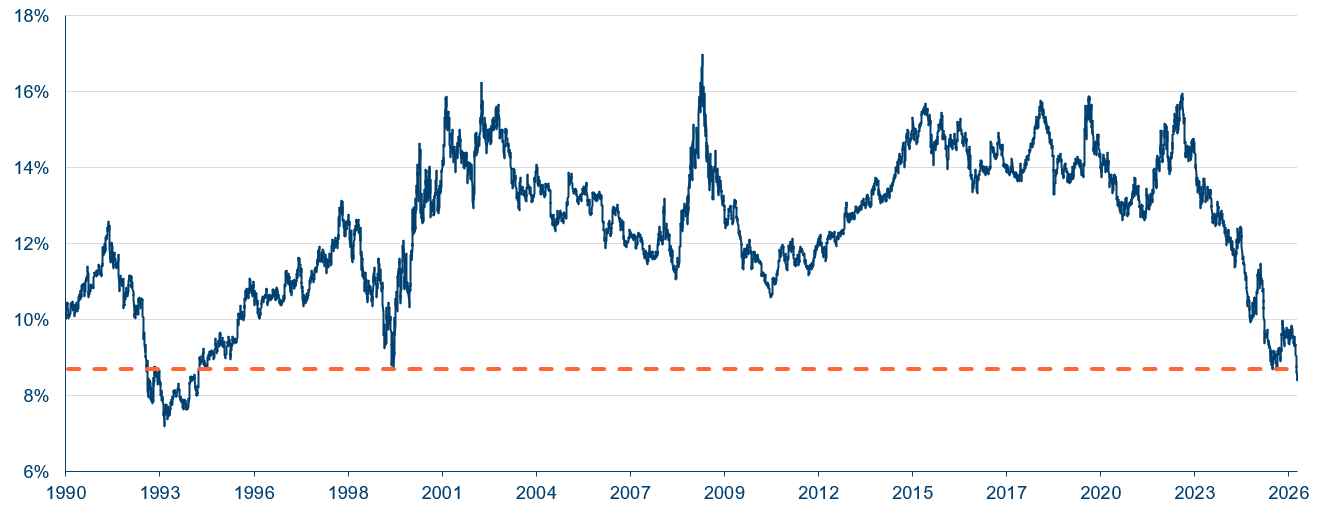 |
Source: Polar Capital, Bloomberg; 30 April 2026. |
The Q1 earnings season was also broadly positive for healthcare companies. Pipeline news flow continues to highlight the high levels of innovation and healthcare is trading at an attractive valuation relative to other sectors, providing what has been seen as a good entry point in the past.
To us, the situation feels similar to the sector’s lows in Q3 2025, with valuations attractive, sentiment poor and fundamentals strong. Healthcare stocks recovered well from that point as there were – and still are – convincing near-term catalysts.
1. Innovation
The first is innovation, the pace of which continues to accelerate. So far in 2026, there have been 14 novel drugs approved by the US Food and Drug Administration (FDA1). This compares to 46 new drugs approved over the course of 2025.
Innovation also extends to delivery devices. In our view, one of the greatest unmet medical needs is improved access to and delivery of care across the globe. At the same time, the associated budgets – whether government, employer or consumer – are increasingly strained. This is likely to ensure the healthcare marketplace will be a prime beneficiary of new technologies.
2. Consolidation
The second catalyst is consolidation. Large pharmaceutical and biotechnology companies need M&A (mergers and acquisitions) to sustain revenue growth as over the next decade some very profitable drugs will lose patent protection. M&A has continued apace since the start of 2026, with a number of significant deals struck at attractive premiums.
| Increased M&A activity in recent months |
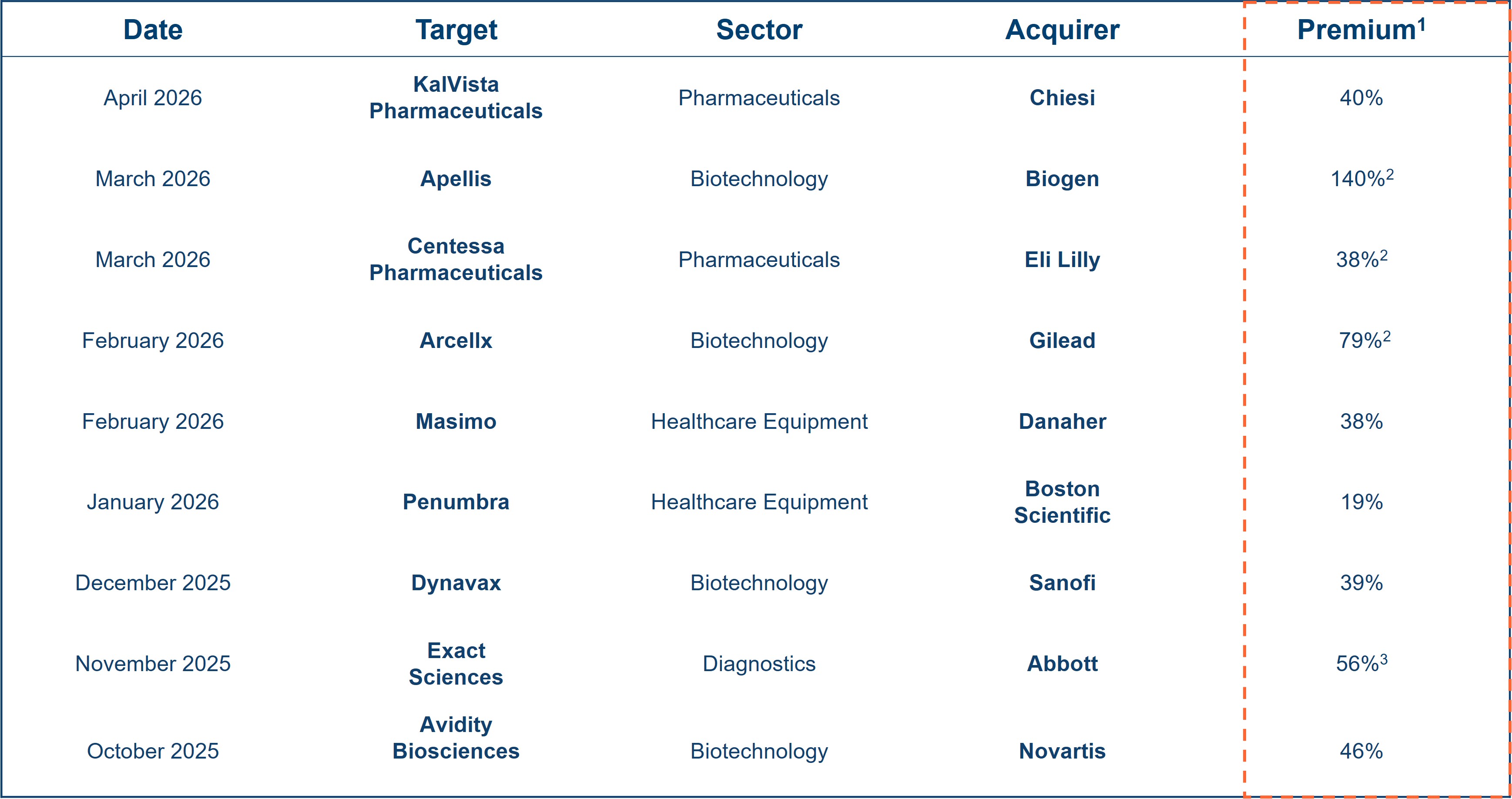 |
| Source: Bloomberg, April 2026 – public to public companies, 1. Based on prior day closing share price unless otherwise stated, 2. Includes cash offer only. 3. Based on prior day closing share price to the initial public disclosure of potential transaction. Past performance is not indicative or a guarantee of future results. |
3. Increasing utilisation
The third catalyst is increasing utilisation. Healthcare utilisation is experiencing a sustained and meaningful uplift globally, driven by demographic forces, evolving patient behaviour and the continued clearing of pandemic-era backlogs. This is supporting revenue and profit growth across companies in a range of subsectors including healthcare distribution, healthcare equipment and healthcare facilities.
Another reason for near-term optimism with regards to investing in the healthcare sector is the mid-term elections in the US, especially if the Democrats claim a majority in the House of Representatives and the Republicans hold on to the Senate. That scenario would effectively create legislative gridlock, with any major healthcare reforms highly unlikely to be signed into law. If policy fears continue to ease, then investors’ attention can be drawn to strong industry fundamentals, attractive valuations and the opportunity to generate returns.
Looking further out, there is a high level of confidence that healthcare companies will continue to innovate and successfully launch new products and devices into large commercial markets. Further, there appears to be a concerted effort to improve access to care and to generate much-needed efficiencies to ensure the outlook for the industry, and investors, is a positive and sustainable one.
How are the Funds positioned?
Against this background, the Polar Capital Healthcare Opportunities and Global Healthcare Select Funds have broad-based sector exposure. We invest across the market-capitalisation spectrum and see real value in many different subsectors which means we can take a very diversified approach.
The funds have the most significant exposure to biotechnology and pharmaceutical sub-sectors because of new product cycles and the potential for M&A.
Also investment in emerging market is likely to increase significantly driven by increasing demand for higher quality healthcare in the relevant countries with India being an example of the opportunity ahead.
Given the strong earnings season, ongoing positive pipeline news flow and the breadth of opportunities we are seeing across a number of healthcare subsectors, we remain optimistic that the recent improved performance is set to continue.
1. Novel Drug Approvals for 2026 | FDA as at 15 May 2026.