
My first day working on what is now the Polar Capital Global Insurance Fund was 03 September 2001. Back then the Fund was part of Hiscox, a well-respected (re)insurer with its roots at Lloyd’s of London. I could not quite believe I was there. While in my final year of qualifying as a chartered accountant, I saw the job advertised in the FT, when you flicked through the Thursday paper pullout section. The role was to work alongside Alec Foster, Hiscox Group Investment Officer and manager of the Hiscox Insurance Portfolio, a £35m Fund that had been launched in 1998. The role demanded at least five years of experience in insurance and investing. The trouble was at that time all I had was almost three years’ experience auditing insurance companies in the London market and my investing experience comprised of punting my student loans in the stock market (not recommended but I did OK). I still applied because after all you miss 100% of the shots you do not take. Somehow, I got the job even after repeatedly pronouncing Warren Buffett’s surname “boo-FAY” in my interview with Alec. Maybe he was impressed that even at the tender age of 24 I had already found a credible hero.

I always expected a steep learning curve. What I did not anticipate was the industry I had joined to be forever changed eight days into my new role. The tragic events of 9/11 redefined the (re)insurance industry, rewriting the laws of underwriting as market participants realised that catastrophes could be caused by man as well as by Mother Nature. (Re)insurers saw risk accumulate across many more classes than they expected with losses coming from aviation, property, business interruption, loss of life, event cancellation and more. Lloyd’s of London was particularly exposed given its focus on specialty risk. There were moments in the weeks that followed when I thought maybe my dream of working in fund management was over before it even got started. Fortunately, the insurance industry prevailed in the aftermath of 9/11 and as I have seen many times now it comes out of these sad events stronger.

What remains undiminished is our determination to deliver strong and consistent returns to clients

Fund management can be a very unforgiving industry. Just being here 25 years later tells me I must be doing something right. The journey of course has not been without challenges. After 9/11 came the catastrophe events in 2005 (Hurricanes Katrina, Rita and Wilma) and the global financial crisis in 2008-09. Early in my second decade was Superstorm Sandy, in 2012, followed by the record catastrophe year of 2017 and then the pandemic of 2020-21. The past five years have included the Russia/Ukraine and Middle Eastern conflicts. We live in an Age of Risk and the risks we face are broad, ever changing and becoming more complex. Insurance companies exist to take the risks and volatility none of us want. There is never a dull moment.

Often staying in the game is about not unnecessarily taking yourself out of it. To borrow an idea from Formula One, to finish first, you must first finish. You improve your odds of survival if you stick to what you know within your circle of competence, think with a margin of safety and remember the fat tails. In insurance language, do not bet the balance sheet. As the years go by and a track record starts to build, you cannot be complacent – you must stay humble or you will be humbled. Insurance fundamentally is the risk business. Working in it means you live in a world of uncertainty every day which helps to keep you grounded. When running an insurance business, you need to think of unknown unknowns and the aggregation of risk. The same is true managing money. You do not want to interrupt the magic of compounding by making a big mistake and having a big drawdown.

What I did not fully appreciate in my early days was just how important insurance is to the functioning of the world economy. All too often people’s perception of insurance, especially in the UK, is influenced by meerkats in TV adverts, poor personal experience with an insurance claim or a story about how a family member lost their shirt at Lloyd’s of London. However, nothing much happens without insurance. Planes would not fly, ships would not sail, your Amazon package would not be delivered and, to be more topical, your data centre would not be built. Insurance really is the oil that greases the wheels of world trade.

However, the industry’s importance is lost somehow as it suffers from a ‘communication gap’. When someone says they work in insurance what often follows is a yawn from the other person as their eyes glaze over. For me, it is a fascinating industry that helps individuals, businesses and society manage uncertainty and transfer risk. It is a first responder when something bad happens in the world, whose job is to restore the unfortunate back to their prior state. The industry provides capital after catastrophes, accidents and other unexpected events, helping communities and economies rebuild. When the industry prices risk it positively influences behaviours and nudges society to respond to threats such as climate change. Let us hope the narrative improves in the years ahead. 

[The key lessons from Warren Buffett and Charlie Munger] are to be a learning machine, be curious, recognise the power of incentives and keep it simple

As I look back on the past 25 years, much has changed but much has stayed the same. What remains undiminished is our determination to deliver strong and consistent returns to clients. Insurance is disconnected to many parts of financial markets and can therefore provide valuable diversification for investors. It is an industry where the power of compounding is evident, something not lost on Warren Buffett many decades ago when Berkshire Hathaway entered the insurance business. Few people are excited about insurance, which leads to relatively steady valuations over time and a strong correlation between stock performance and growth in book value and dividends per share.

Let us look at my 25-year scorecard. Of course, it is not just mine. From 2001 until 2007 I was Alec’s analyst and we were then Fund Co-Managers from 2008 to 2015. I had full responsibility of the Fund from 2016-22, since when I have been Lead Fund Manager with Dominic Evans after he was promoted from Analyst to Fund Manager. I am very proud of the 25-year numbers shown here. The Fund performance is based on the Retail share class; returns for institutional investors are 50bps per annum higher and in double-digit territory. 
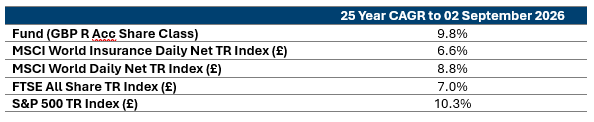
25 Year CAGR to 02 September 2026
Source: Polar Capital, September 2026. Past performance is not a reliable guide to future performance. The value of investments may go down as well as up and you might get back less than you originally invested as there is no guarantee in place.

The Fund has had a simple process from day one which I quickly learned and have adopted ever since: find the best 30-35 specialty insurance businesses and own them for the long term. When asked for the key to their success, both Warren Buffett and Bill Gates said “focus”. We have always had that. Luckily for me it has meant I have not had to think too hard about the macro or politics as these do not materially impact the insurance business. However, I have always been conscious that when managing a sector-specific fund, you can take focus too far. For a long time, I have appreciated the need for us to look beyond our own insurance goldfish bowl. This is even more critical in today’s AI and tech world of exponential change. After all, to a man with a hammer everything looks like a nail. I try and keep in mind how much importance Charlie Munger gave to multi-disciplinary thinking.

I was lucky enough to discover Warren Buffett and Charlie Munger during my teenage years and they have been heroes ever since. I have attended in person the Berkshire Hathaway annual meeting 16 times and have been lucky to meet both of them. Their lessons are endless, with key ones including to be a learning machine, be curious, recognise the power of incentives and keep it simple. Their lessons and wisdom transcend finance.

Top of my list is the importance of compounding. Everything compounds over time which shows the value of a long-time horizon. The second quarter this year was my 100th earnings season. Each earnings result is a snapshot in time, but when you put those pictures together you get a movie. Some of our movies of the companies we have invested in have been a great watch and there is more to look forward to. Compounding is most thought of in financial terms, but compounding works everywhere, for example relationships, health, in nature and sleep. It really pays to adopt habits whose benefits can then compound over time. Often these habits compound on each other, leading to what Charlie called a “Lollapalooza Effect”.

The insurance industry prevailed in the aftermath of 9/11 and as I have seen many times now it comes out of these sad events stronger

Over 25 years, £1,000 invested in the Fund on 3 September 2001 has compounded to £10,340 to the end of July 2026. Over the same timeframe, the Fund has grown from £35m when I started to £2.4bn. It has been a steady journey more than a spectacular rollercoaster with returns coming typically in the more challenging times for the economy and financial markets, reflecting the defensive qualities of the non-life insurance industry.

I often think intensity and excitement can be overrated and consistency underrated. I am very happy with the Fund being at the ‘dull and boring’ end of the spectrum. I have always described it as having a ‘get rich slow, compounding of returns’ profile. Nothing goes up in a straight line so sometimes that requires patience but I remain convinced, even at times when the voting machine is in overdrive, that it is the weighing machine that ultimately wins.

I am always reminded of the fact that 99% of Warren Buffett’s wealth came after his 65th birthday. That last double makes a huge difference. This is well articulated by Morgan Housel, one of my favourite authors and thinkers and a person who I have been lucky to meet in Omaha: “A great irony in finance is that the fastest way to get rich is often to go slow…Like so many things in life, speed gets all the attention but slow has all the power.”

I believe the Fund can continue its strong absolute and relative performance for many years to come. None of this would have been possible without Alec giving that young boy a chance and I remain very grateful for his trust, mentorship and friendship that began a quarter of a century ago. I would also like to thank all my colleagues at Hiscox and Polar Capital over the years for their support. Fund management is a team sport. Looking ahead, Warren and Charlie have set the bar high. My next 25 years start now. 

Risks

  • Capital is at risk and there is no guarantee the Fund will achieve its objective. Investors should make sure their attitude towards risk is aligned with the risk profile of the Fund before investing.
  • Past performance is not a reliable guide to future performance. The value of investments may go down as well as up and you might get back less than you originally invested as there is no guarantee in place.
  • The value of a fund’s assets may be affected by uncertainties such as international political developments, market sentiment, economic conditions, changes in government policies, restrictions on foreign investment and currency repatriation, currency fluctuations and other developments in the laws and regulations of countries in which investment may be made. Please see the Fund’s Prospectus for details of all risks.
  • The fund is exposed to Sustainability risks which are environmental, social and governance factors that could have an actual or potential material negative impact on the value of the Fund and its risk factors.
  • The Fund invests in the shares of companies and share prices can rise or fall due to several factors affecting global stock markets.
  • The Fund uses derivatives which carry the risk of reduced liquidity, substantial loss and increased volatility in adverse market conditions, such as failure amongst market participants.
  • The Fund invests in assets denominated in currencies other than the Fund's base currency. Changes in exchange rates may have a negative impact on the Fund's investments. If the share class currency is different from the currency of the country in which you reside, exchange rate fluctuations may affect your returns when converted into your local currency.
  • The Fund invests in a relatively concentrated number of companies and industries based in one sector. This focused strategy can produce high gains but can also lead to significant losses. The Fund may be less diversified than other investment funds.


Important Information:
This is a marketing communication and does not constitute a solicitation or offer to any person to buy or sell any related securities or financial instruments. Any opinions expressed may change. This document does not contain information material to the investment objectives or financial needs of the recipient. This document is not advice on legal, taxation or investment matters. Tax treatment depends on personal circumstances. Investors must rely on their own examination of the fund or seek advice. Investment may be restricted in other countries and as such, any individual who receives this document must make themselves aware of their respective jurisdiction and observe any restrictions.

A decision may be taken at any time to terminate the marketing of the Fund in any EEA Member State in which it is currently marketed. Shareholders in the affected EEA Member State will be given notification of any decision and provided the opportunity to redeem their interests in the Fund, free of any charges or deductions, for at least 30 working days from the date of the notification.

Investment in the Fund is an investment in the shares of the Fund and not in the underlying investments of the Fund. Further information about fund characteristics and any associated risks can be found in the Fund’s Key Information Document or Key Investor Information Document (“KID” or “KIID”), the Prospectus (and relevant Fund Supplement), the Articles of Association and the Annual and Semi-Annual Reports. Please refer to these documents before making any final investment decisions. These documents are available free of charge at Polar Capital Funds plc, Georges Court, 54-62 Townsend Street, Dublin 2, Ireland, via email by contacting Investor-Relations@polarcapitalfunds.com or at www.polarcapital.co.uk. The KID is available in the languages of all EEA member states in which the Fund is registered for sale; the Prospectus, Annual and Semi-Annual Reports and KIID are available in English.

The Fund promotes, among other characteristics, environmental or social characteristics and is classified as an Article 8 fund under the EU's Sustainable Finance Disclosure Regulation (SFDR). For more information, please see the Prospectus and relevant Fund Supplement.

ESG and sustainability characteristics are further detailed on the investment manager’s website: - https://www.polarcapital.co.uk/ESG-and-Sustainability/Responsible-Investing/.

A summary of investor rights associated with investment in the Fund can be found here.

This document is provided and approved by both Polar Capital LLP and Polar Capital (Europe) SAS.

Polar Capital LLP is authorised and regulated by the Financial Conduct Authority (“FCA”) in the United Kingdom, and the Securities and Exchange Commission (“SEC”) in the United States. Polar Capital LLP’s registered address is 16 Palace Street, London, SW1E 5JD, United Kingdom.

Polar Capital (Europe) SAS is authorised and regulated by the Autorité des marchés financiers (AMF) in France. Polar Capital (Europe) SAS’s registered address is 18 Rue de Londres, Paris 75009, France.

Polar Capital LLP is a registered Investment Advisor with the SEC. Polar Capital LLP is the investment manager and promoter of Polar Capital Funds plc – an open-ended investment company with variable capital and with segregated liability between its sub-funds – incorporated in Ireland, authorised by the Central Bank of Ireland and recognised by the FCA. FundRock Management Company (Ireland) Limited acts as management company and is regulated by the Central Bank of Ireland. Registered Address: Percy Exchange, 8/34 Percy Place, Dublin 4, Ireland.

For UK investors: The Fund is recognised in the UK under the Overseas Funds Regime (OFR) but it is not a UK-authorised Fund. UK investors should be aware that they may not be able to refer a complaint against its Management Company or its Depositary to the UK’s Financial Ombudsman Service. Any claims for losses relating to the Management Company or the Depositary will not be covered by the Financial Services Compensation Scheme, in the event that either entity should become unable to meet its liabilities to investors. For information on the complaint process to the Management Company, please see the Country Supplement for this fund available at https://www.polarcapital.co.uk/

Benchmark: The Fund is actively managed and uses the MSCI Daily TR World Net Insurance Index as a performance target and to calculate the performance fee. The benchmark has been chosen as it is generally considered to be representative of the investment universe in which the Fund invests. The performance of the Fund is likely to differ from the performance of the benchmark as the holdings, weightings and asset allocation will be different. Investors should carefully consider these differences when making comparisons. Further information about the benchmark can be found here. The benchmark is provided by an administrator on the European Securities and Markets Authority (ESMA) register of benchmarks which includes details of all authorised, registered, recognised and endorsed EU and third country benchmark administrators together with their national competent authorities.

Third-party Data: Some information contained herein has been obtained from third party sources and has not been independently verified by Polar Capital. Neither Polar Capital nor any other party involved in or related to compiling, computing or creating the data makes any express or implied warranties or representations with respect to such data (or the results to be obtained by the use thereof), and all such parties hereby expressly disclaim all warranties of originality, accuracy, completeness, merchantability or fitness for a particular purpose with respect to any data contained herein.

Country Specific Disclaimers: Please be aware that not every share class of every fund is available in all jurisdictions. When considering an investment into the Fund, you should make yourself aware of the relevant financial, legal and tax implications. Neither Polar Capital LLP nor Polar Capital Funds plc shall be liable for, and accept no liability for, the use or misuse of this document.

None

My first day working on what is now the Polar Capital Global Insurance Fund was 03 September 2001. Back then the Fund was part of Hiscox, a well-respected (re)insurer with its roots at Lloyd’s of London. I could not quite believe I was there. While in my final year of qualifying as a chartered accountant, I saw the job advertised in the FT, when you flicked through the Thursday paper pullout section. The role was to work alongside Alec Foster, Hiscox Group Investment Officer and manager of the Hiscox Insurance Portfolio, a £35m Fund that had been launched in 1998. The role demanded at least five years of experience in insurance and investing. The trouble was at that time all I had was almost three years’ experience auditing insurance companies in the London market and my investing experience comprised of punting my student loans in the stock market (not recommended but I did OK). I still applied because after all you miss 100% of the shots you do not take. Somehow, I got the job even after repeatedly pronouncing Warren Buffett’s surname “boo-FAY” in my interview with Alec. Maybe he was impressed that even at the tender age of 24 I had already found a credible hero.

I always expected a steep learning curve. What I did not anticipate was the industry I had joined to be forever changed eight days into my new role. The tragic events of 9/11 redefined the (re)insurance industry, rewriting the laws of underwriting as market participants realised that catastrophes could be caused by man as well as by Mother Nature. (Re)insurers saw risk accumulate across many more classes than they expected with losses coming from aviation, property, business interruption, loss of life, event cancellation and more. Lloyd’s of London was particularly exposed given its focus on specialty risk. There were moments in the weeks that followed when I thought maybe my dream of working in fund management was over before it even got started. Fortunately, the insurance industry prevailed in the aftermath of 9/11 and as I have seen many times now it comes out of these sad events stronger.

What remains undiminished is our determination to deliver strong and consistent returns to clients

Fund management can be a very unforgiving industry. Just being here 25 years later tells me I must be doing something right. The journey of course has not been without challenges. After 9/11 came the catastrophe events in 2005 (Hurricanes Katrina, Rita and Wilma) and the global financial crisis in 2008-09. Early in my second decade was Superstorm Sandy, in 2012, followed by the record catastrophe year of 2017 and then the pandemic of 2020-21. The past five years have included the Russia/Ukraine and Middle Eastern conflicts. We live in an Age of Risk and the risks we face are broad, ever changing and becoming more complex. Insurance companies exist to take the risks and volatility none of us want. There is never a dull moment.

Often staying in the game is about not unnecessarily taking yourself out of it. To borrow an idea from Formula One, to finish first, you must first finish. You improve your odds of survival if you stick to what you know within your circle of competence, think with a margin of safety and remember the fat tails. In insurance language, do not bet the balance sheet. As the years go by and a track record starts to build, you cannot be complacent – you must stay humble or you will be humbled. Insurance fundamentally is the risk business. Working in it means you live in a world of uncertainty every day which helps to keep you grounded. When running an insurance business, you need to think of unknown unknowns and the aggregation of risk. The same is true managing money. You do not want to interrupt the magic of compounding by making a big mistake and having a big drawdown.

What I did not fully appreciate in my early days was just how important insurance is to the functioning of the world economy. All too often people’s perception of insurance, especially in the UK, is influenced by meerkats in TV adverts, poor personal experience with an insurance claim or a story about how a family member lost their shirt at Lloyd’s of London. However, nothing much happens without insurance. Planes would not fly, ships would not sail, your Amazon package would not be delivered and, to be more topical, your data centre would not be built. Insurance really is the oil that greases the wheels of world trade.

However, the industry’s importance is lost somehow as it suffers from a ‘communication gap’. When someone says they work in insurance what often follows is a yawn from the other person as their eyes glaze over. For me, it is a fascinating industry that helps individuals, businesses and society manage uncertainty and transfer risk. It is a first responder when something bad happens in the world, whose job is to restore the unfortunate back to their prior state. The industry provides capital after catastrophes, accidents and other unexpected events, helping communities and economies rebuild. When the industry prices risk it positively influences behaviours and nudges society to respond to threats such as climate change. Let us hope the narrative improves in the years ahead. 

[The key lessons from Warren Buffett and Charlie Munger] are to be a learning machine, be curious, recognise the power of incentives and keep it simple

As I look back on the past 25 years, much has changed but much has stayed the same. What remains undiminished is our determination to deliver strong and consistent returns to clients. Insurance is disconnected to many parts of financial markets and can therefore provide valuable diversification for investors. It is an industry where the power of compounding is evident, something not lost on Warren Buffett many decades ago when Berkshire Hathaway entered the insurance business. Few people are excited about insurance, which leads to relatively steady valuations over time and a strong correlation between stock performance and growth in book value and dividends per share.

Let us look at my 25-year scorecard. Of course, it is not just mine. From 2001 until 2007 I was Alec’s analyst and we were then Fund Co-Managers from 2008 to 2015. I had full responsibility of the Fund from 2016-22, since when I have been Lead Fund Manager with Dominic Evans after he was promoted from Analyst to Fund Manager. I am very proud of the 25-year numbers shown here. The Fund performance is based on the Retail share class; returns for institutional investors are 50bps per annum higher and in double-digit territory. 

25 Year CAGR to 02 September 2026
Source: Polar Capital, September 2026. Past performance is not a reliable guide to future performance. The value of investments may go down as well as up and you might get back less than you originally invested as there is no guarantee in place.

The Fund has had a simple process from day one which I quickly learned and have adopted ever since: find the best 30-35 specialty insurance businesses and own them for the long term. When asked for the key to their success, both Warren Buffett and Bill Gates said “focus”. We have always had that. Luckily for me it has meant I have not had to think too hard about the macro or politics as these do not materially impact the insurance business. However, I have always been conscious that when managing a sector-specific fund, you can take focus too far. For a long time, I have appreciated the need for us to look beyond our own insurance goldfish bowl. This is even more critical in today’s AI and tech world of exponential change. After all, to a man with a hammer everything looks like a nail. I try and keep in mind how much importance Charlie Munger gave to multi-disciplinary thinking.

I was lucky enough to discover Warren Buffett and Charlie Munger during my teenage years and they have been heroes ever since. I have attended in person the Berkshire Hathaway annual meeting 16 times and have been lucky to meet both of them. Their lessons are endless, with key ones including to be a learning machine, be curious, recognise the power of incentives and keep it simple. Their lessons and wisdom transcend finance.

Top of my list is the importance of compounding. Everything compounds over time which shows the value of a long-time horizon. The second quarter this year was my 100th earnings season. Each earnings result is a snapshot in time, but when you put those pictures together you get a movie. Some of our movies of the companies we have invested in have been a great watch and there is more to look forward to. Compounding is most thought of in financial terms, but compounding works everywhere, for example relationships, health, in nature and sleep. It really pays to adopt habits whose benefits can then compound over time. Often these habits compound on each other, leading to what Charlie called a “Lollapalooza Effect”.

The insurance industry prevailed in the aftermath of 9/11 and as I have seen many times now it comes out of these sad events stronger

Over 25 years, £1,000 invested in the Fund on 3 September 2001 has compounded to £10,340 to the end of July 2026. Over the same timeframe, the Fund has grown from £35m when I started to £2.4bn. It has been a steady journey more than a spectacular rollercoaster with returns coming typically in the more challenging times for the economy and financial markets, reflecting the defensive qualities of the non-life insurance industry.

I often think intensity and excitement can be overrated and consistency underrated. I am very happy with the Fund being at the ‘dull and boring’ end of the spectrum. I have always described it as having a ‘get rich slow, compounding of returns’ profile. Nothing goes up in a straight line so sometimes that requires patience but I remain convinced, even at times when the voting machine is in overdrive, that it is the weighing machine that ultimately wins.

I am always reminded of the fact that 99% of Warren Buffett’s wealth came after his 65th birthday. That last double makes a huge difference. This is well articulated by Morgan Housel, one of my favourite authors and thinkers and a person who I have been lucky to meet in Omaha: “A great irony in finance is that the fastest way to get rich is often to go slow…Like so many things in life, speed gets all the attention but slow has all the power.”

I believe the Fund can continue its strong absolute and relative performance for many years to come. None of this would have been possible without Alec giving that young boy a chance and I remain very grateful for his trust, mentorship and friendship that began a quarter of a century ago. I would also like to thank all my colleagues at Hiscox and Polar Capital over the years for their support. Fund management is a team sport. Looking ahead, Warren and Charlie have set the bar high. My next 25 years start now. 

Related Fund

Get the latest insights sent straight to your inbox

Risks

  • Capital is at risk and there is no guarantee the Fund will achieve its objective. Investors should make sure their attitude towards risk is aligned with the risk profile of the Fund before investing.
  • Past performance is not a reliable guide to future performance. The value of investments may go down as well as up and you might get back less than you originally invested as there is no guarantee in place.
  • The value of a fund’s assets may be affected by uncertainties such as international political developments, market sentiment, economic conditions, changes in government policies, restrictions on foreign investment and currency repatriation, currency fluctuations and other developments in the laws and regulations of countries in which investment may be made. Please see the Fund’s Prospectus for details of all risks.
  • The fund is exposed to Sustainability risks which are environmental, social and governance factors that could have an actual or potential material negative impact on the value of the Fund and its risk factors.
  • The Fund invests in the shares of companies and share prices can rise or fall due to several factors affecting global stock markets.
  • The Fund uses derivatives which carry the risk of reduced liquidity, substantial loss and increased volatility in adverse market conditions, such as failure amongst market participants.
  • The Fund invests in assets denominated in currencies other than the Fund's base currency. Changes in exchange rates may have a negative impact on the Fund's investments. If the share class currency is different from the currency of the country in which you reside, exchange rate fluctuations may affect your returns when converted into your local currency.
  • The Fund invests in a relatively concentrated number of companies and industries based in one sector. This focused strategy can produce high gains but can also lead to significant losses. The Fund may be less diversified than other investment funds.


Important Information:
This is a marketing communication and does not constitute a solicitation or offer to any person to buy or sell any related securities or financial instruments. Any opinions expressed may change. This document does not contain information material to the investment objectives or financial needs of the recipient. This document is not advice on legal, taxation or investment matters. Tax treatment depends on personal circumstances. Investors must rely on their own examination of the fund or seek advice. Investment may be restricted in other countries and as such, any individual who receives this document must make themselves aware of their respective jurisdiction and observe any restrictions.

A decision may be taken at any time to terminate the marketing of the Fund in any EEA Member State in which it is currently marketed. Shareholders in the affected EEA Member State will be given notification of any decision and provided the opportunity to redeem their interests in the Fund, free of any charges or deductions, for at least 30 working days from the date of the notification.

Investment in the Fund is an investment in the shares of the Fund and not in the underlying investments of the Fund. Further information about fund characteristics and any associated risks can be found in the Fund’s Key Information Document or Key Investor Information Document (“KID” or “KIID”), the Prospectus (and relevant Fund Supplement), the Articles of Association and the Annual and Semi-Annual Reports. Please refer to these documents before making any final investment decisions. These documents are available free of charge at Polar Capital Funds plc, Georges Court, 54-62 Townsend Street, Dublin 2, Ireland, via email by contacting Investor-Relations@polarcapitalfunds.com or at www.polarcapital.co.uk. The KID is available in the languages of all EEA member states in which the Fund is registered for sale; the Prospectus, Annual and Semi-Annual Reports and KIID are available in English.

The Fund promotes, among other characteristics, environmental or social characteristics and is classified as an Article 8 fund under the EU's Sustainable Finance Disclosure Regulation (SFDR). For more information, please see the Prospectus and relevant Fund Supplement.

ESG and sustainability characteristics are further detailed on the investment manager’s website: - https://www.polarcapital.co.uk/ESG-and-Sustainability/Responsible-Investing/.

A summary of investor rights associated with investment in the Fund can be found here.

This document is provided and approved by both Polar Capital LLP and Polar Capital (Europe) SAS.

Polar Capital LLP is authorised and regulated by the Financial Conduct Authority (“FCA”) in the United Kingdom, and the Securities and Exchange Commission (“SEC”) in the United States. Polar Capital LLP’s registered address is 16 Palace Street, London, SW1E 5JD, United Kingdom.

Polar Capital (Europe) SAS is authorised and regulated by the Autorité des marchés financiers (AMF) in France. Polar Capital (Europe) SAS’s registered address is 18 Rue de Londres, Paris 75009, France.

Polar Capital LLP is a registered Investment Advisor with the SEC. Polar Capital LLP is the investment manager and promoter of Polar Capital Funds plc – an open-ended investment company with variable capital and with segregated liability between its sub-funds – incorporated in Ireland, authorised by the Central Bank of Ireland and recognised by the FCA. FundRock Management Company (Ireland) Limited acts as management company and is regulated by the Central Bank of Ireland. Registered Address: Percy Exchange, 8/34 Percy Place, Dublin 4, Ireland.

For UK investors: The Fund is recognised in the UK under the Overseas Funds Regime (OFR) but it is not a UK-authorised Fund. UK investors should be aware that they may not be able to refer a complaint against its Management Company or its Depositary to the UK’s Financial Ombudsman Service. Any claims for losses relating to the Management Company or the Depositary will not be covered by the Financial Services Compensation Scheme, in the event that either entity should become unable to meet its liabilities to investors. For information on the complaint process to the Management Company, please see the Country Supplement for this fund available at https://www.polarcapital.co.uk/

Benchmark: The Fund is actively managed and uses the MSCI Daily TR World Net Insurance Index as a performance target and to calculate the performance fee. The benchmark has been chosen as it is generally considered to be representative of the investment universe in which the Fund invests. The performance of the Fund is likely to differ from the performance of the benchmark as the holdings, weightings and asset allocation will be different. Investors should carefully consider these differences when making comparisons. Further information about the benchmark can be found here. The benchmark is provided by an administrator on the European Securities and Markets Authority (ESMA) register of benchmarks which includes details of all authorised, registered, recognised and endorsed EU and third country benchmark administrators together with their national competent authorities.

Third-party Data: Some information contained herein has been obtained from third party sources and has not been independently verified by Polar Capital. Neither Polar Capital nor any other party involved in or related to compiling, computing or creating the data makes any express or implied warranties or representations with respect to such data (or the results to be obtained by the use thereof), and all such parties hereby expressly disclaim all warranties of originality, accuracy, completeness, merchantability or fitness for a particular purpose with respect to any data contained herein.

Country Specific Disclaimers: Please be aware that not every share class of every fund is available in all jurisdictions. When considering an investment into the Fund, you should make yourself aware of the relevant financial, legal and tax implications. Neither Polar Capital LLP nor Polar Capital Funds plc shall be liable for, and accept no liability for, the use or misuse of this document.